Reading Assignment 30: Reacting to Challenging Behaviors with De-escalation & "Mind the Gap"
Reacting to Challenging Behavior
De-escalation
Consider the following de-escalation tips from A Gentle Response: Conflict De-Escalation with a Ministry Mindset by John Riley. He defines de-escalation as “lowering the intensity of an agitated person” and suggests:
- Be calm and patient, giving the person time.
- Listen, letting the person vent their anger and energy without taking it personally.
- Smile.
- Maintain a reactionary gap of space (arm’s length or more).
- Breathe (slowly, deeply, like “square-breathing”).
- Connect over something in common.
- Pray for strength, guidance, and discernment.
According to Riley, interaction can be shifted based on a person’s ACE -appearance, communication, and engagement.
Appearance
Body language, facial expression, and posture that is non-threatening, non-judgmental, and unintimidating is most helpful. Keep shoulders relaxed, hands in front, body at a slight angle.
Communication
Use a calm, soft tone of voice and words that come out gently to ask, “how can I help?” and say, “I’m sorry.”
Engagement
Show you are focused on the person by keeping eye contact with them, repeating comments you hear them say, and deeply listening to them.
Mind the Gap
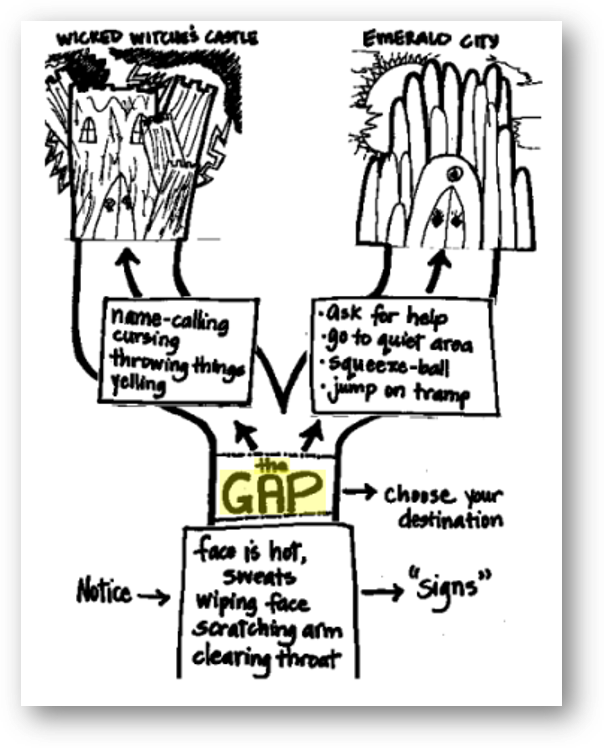
"Mind the gap" is the phrase heard in London when passengers board the tube (underground train). A teacher from North Carolina in the United States, who worked with students who have autism spectrum disorder was traveling in London and heard this phrase called out at each station. He pondered the phrase's meaning and how it applied to the behaviors of his students at the Charlotte TEACCH Center and was inspired to create a visual diagram to use with his students. He describes the "the gap" as the moment between a stressful incident and the response it provokes.Using the visual model allows for students and teachers to stop and work through the stressful moment, or the moment of decision ("mind the gap") before taking action. This technique is effective with students with autism, but also effective for teaching children and youth of all ages, stages, and abilities, particularly those who may struggle with self-regulation. That is, the ability to notice, and recognize emotions and responses in oneself, and to make choices to control them. This model helps children and youth to put on paper (or on a whiteboard or chalkboard, written in sand, whatever works in the setting) and see the choice available to them, consequences of the choice, and also to identify the starting point (the point at which an action is called for).
For example, a child may be feeling hungry while a leader or teacher is teaching a Bible lesson. The child sees a snack that is prepared for after the lesson. As the feeling of hunger gets stronger, the child has to make a choice about that feeling. Ignore the hunger and stay with the lesson, waiting for the leader to give the snack, or alleviate the hunger (ignoring the lesson) by taking the snack. A reactive behavior management approach might notice the child take the snack and scold the child by asking, "Why did you take the snack while we were doing our lesson?". The child may or may not be honest, and may or may not recognize the feelings and choices that led to this action. A proactive, interactive approach would use "Mind the Gap" with the child and help the child to see:
The feeling or stressor was hunger. Choosing to take the snack leads to disruption. Choosing to wait (perhaps ask about the snack, tell the leader about the hunger) leads to a smooth completion of the lesson and everyone enjoying snack together.
After you read the brief excerpt, think about a time in the last 24 hours in which you had to make a choice (however simple), and draw the "Mind the Gap" diagram to see your own stressor/moment of decision, the choices that were available, and the outcomes of those choices.
Read pages 262-265 from Asperger's...What Does it Mean to Me? A Workbook Explaining Self Awareness by Catherine Flaherty, describing the technique created by Jack Wall. Note that visuals, especially those created with the individual, are key to this technique working well. The example in the book is pictured here for you: