
Reading Assignment 10: Accessible Gospel, Inclusive Worship pp. 36-38, 79
Accessible Conversation With God
Accessibility. I used that word to help us think about the gospel message. How do we make that more accessible to each one? Now imagine accessibility in church, a small group setting, and individual settings. While it’s easy to think about issues like bathrooms, ramps, drinking fountains, pew cut outs for wheelchair users, and elevators, walk with me more deeply into this concept.
Most of our worship settings can be described as a conversation. While some of them are corporate and others are individual, we enter into a place where we speak to God and allow God to speak to our lives. For some individuals with disabilities, the tools we use as part of that conversation might be a bit different from some of the traditional tools. For example, if we use only spoken words set to music for the part of the conversation that says “I love you, God,” then we have left someone out who has no spoken words. How can we make that part of our conversation with God inclusive of each worshipper?
While drinking fountains and bathrooms are very important, the focus of this book will be on the tools and techniques one might use in including persons with intellectual disability, autism spectrum disorder, or physical challenges that might prevent the use of more traditional tools in a worship setting. If, however, your congregation has not had the chance to look at your physical property, I recommend beginning with www.crcna.org/disability and click on the link for the accessibility audit guide[1].
Concept Of Vertical Habits
Tom and Sally have been thrilled since they first knew that they would have a child. They prepared a safe and comfortable place for the baby to sleep, and their friends gave gifts of clothing, warm blankets and stuffed animals. And finally baby Asher arrived. They can hardly believe that this child was entrusted to them. They have prayed that the child would be healthy, would grow, and would come to love God as they do.
Before Asher can begin to understand, Tom and Sally are practicing habits of relating. They smile at him, talk to him, sing, laugh and quickly respond to his every need. Over and over they repeat “I love you.” Their deepest desire is that a deep and loving bond will grow between Asher and them, their family, friends and God.
Their love is expressed not only in words but in actions. They eagerly watch for smiles from Asher that are a response to their love. As Asher grows they begin to teach him expressions that will help these bonds grow.
It would be three years before Tom and Sally receive the diagnosis that Asher has autism spectrum disorder. Though these years have been filled with frustration and uncertainty, they have been reminded that God loves Asher and desires to have a relationship with him. They know that God wants Asher to be deeply connected with his parents, siblings, and family and friends who love him.
As Asher grows they want to help him learn to express” Thank you” either in words or gestures. When he is older they’ll teach him the importance of “I’m Sorry” and “Please help.”
Asher, as is true for all of us, also needs to learn practices of relating to God. In many Christian churches, worship is shaped by these practices. In 2005 Dr. John Witvliet of the Calvin Institute of Christian Worship taught this concept in a workshop in Denver. Bruce Gritter and Karen Wilk, church planters in Edmonton, Alberta wondered whether this might help new believers understand why we do what we do in worship. Thinking of human relationships as horizontal and relating to God as vertical, they called it “Vertical Habits” and spent a year learning and practicing 8 habits.
After receiving their reports and resources, Calvin Institute of Christian Worship staff wondered,
Would this framework be effective in congregations filled with life-long Christians?
Might Christian schools shape faith formation using the Vertical Habits?
Would it be meaningful in churches of various ethnicities and worship practices?
Twenty-three churches and schools accepted an invitation to learn about Vertical Habits and practice them for a year. At the end of the year they shared resources and reflections.
I also had a chance to work with the Vertical Habits project. My role was to consider how this language, this new way of looking at elements of a worship service and growing as a Christian, might impact the life of a person with a disability. There was such beauty in the way large words like “adoration,” “confession,” or “prayer for illumination” could be looked at much more simply. “Love you,” “Sorry,” and “I’m listening” often make more sense not only to new Christians but also to those with more concrete vocabularies. In fact, Vertical Habits impacted my conversation with God as well.
In addition, I had learned as a special educator that repetition is really important for my students. Practicing the same concept in a variety of ways was pivotal to learning new concepts. The same would be true for growing as a Christian. In that way, the use of the word “habit” was also a delight for me. In order to think about the topic of Christian or spiritual formation, the idea of building habits of saying “I love you” to God seemed really important. This vocabulary could be practiced in corporate settings, but also at home before bedtime.
As I looked more deeply into the concept of Vertical Habits, it not only made sense in allowing a person with a disability to enter into worship and grow as a Christian, it also seemed to be a common denominator for all who are worshippers of Jesus Christ. Vertical Habits, therefore, opened the doors to inclusive worship opportunities – a place where all believers can practice these habits and words together.
Since launching this project, many churches, schools, and families have found that the Vertical Habits help both adults and children grow in their relationship with God. In fact, it’s become the structure With Ministries uses when suggesting ideas for Christian formation and including persons with disabilities in corporate worship settings. Other names have sometimes been used to describe the process such as “Created to Worship” and “Growing Towards God.” The Psalms provide a biblical guide to shape the process both in worship and in relationships. Churches, schools, and individuals that use Vertical Habits say it helps develop worship habits that deepen their relationship with God and affect every part of their lives. A school which recently spent a year with Vertical Habits reported, “We will never be the same.”
Vertical Habits At A Glance
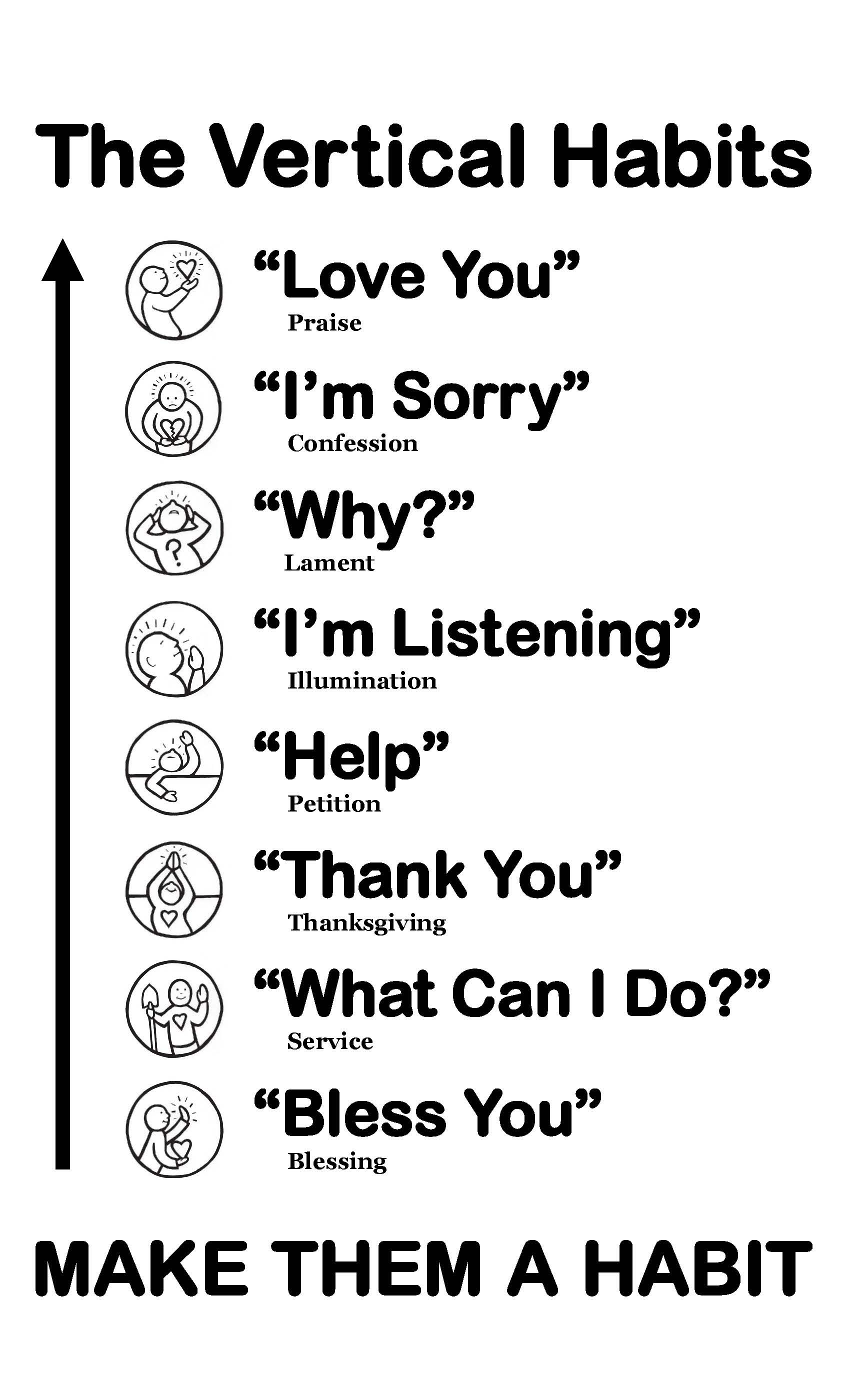
Why Habits Are Important
We teach children to brush their teeth regularly so that as they grow it becomes a habit. We teach children to say thank you so that any time someone does something kind for them they respond with gratitude. Helping children and adults develop habits in their relationship with God will help them grow throughout their lives.
These habits can shape our response to a sunset or a siren. We can give thanks to God for the beautiful colors in the sky. We might offer a prayer of protection for the stranger whose life is changed by some trauma that requires the response of the emergency vehicle. Vertical Habits can help people of all ages and abilities develop habits that will point them to God in the circumstances of everyday life. And in so doing, faith is shaped and strengthened.
[1] www.faithward.org/everybody-belongs-serving-together/church-accessibility-audit/ is an excellent audit that has three components: Attitude, Communication, Physical Access
Whether children, youth, or adults, consider how you will resource your congregation, school, or small group. In many respects, there are two levels of preparation. On one hand, you may want to begin a general preparation without bringing in the gifts and needs of a specific individual. Consider the following:
1. Have the governing board of your church or organization study the biblical reasons for including persons with disabilities. A great place to begin is at www.withministries.org.
2. Look into your church denominational materials. Many have statements and even extensive resources that support the topic of including persons with disabilities. Some denominations even have support personnel who can give ideas to your community.
3. Consider highlighting this topic as part of a sermon series. If you need ideas, there is great support at www.crcna.org/disability.
4. As a church community or small group, consider a book study on a topic related to including persons with disabilities. Body Building: Devotions to Celebrate Inclusive Community is one example of a resource that could be used with multiple ages.
5. Show a video that highlights this topic. While there are many available, finding one from a Christian perspective is helpful. It will anchor people in the reasons why we include from a biblical perspective.
6. Invite a local speaker, parent, or individual with a disability to come to your community and give a presentation.
7. Make a puzzle piece display that highlights the gifts and needs of each member of your group. Instructions are available in chapter 6 of Worship As One: Varied Abilities in the Body of Christ.
8. Stock your library or resource center with books and materials dedicated to this topic.