
Transcript & Slides: Turning the World Upside Down
The Book of Acts: Turning the World Upside Down
By David Feddes
If I had to summarize what the book of Acts is all about, there are two basic statements that I would choose. One is a statement from Jesus himself, which gives the overview of the book of Acts. And another is a statement of those who didn't like what was happening, as the Christians spread the gospel.
The statement of Jesus is this: "You will receive power when the Holy Spirit has come upon you. And you will be my witnesses in Jerusalem and in all Judea and Samaria, and to the ends of the earth" (Acts 1:8). The book of Acts follows that outline—what the witnesses of Jesus do in Jerusalem after they've been empowered by the Holy Spirit, and then spreading outward to Judea and Samaria, and then much further out into other parts of the world. Power from the Holy Spirit to be Jesus' witnesses.
The other statement I would use to summarize Acts is Acts 17:6, where some people complain of the apostles: "These men who have turned the world upside down have come here also." They're griping that everywhere these men go, there is a great upheaval. Of course, from the Christian point of view, they were turning the world right side up.
At any rate, those two statements express what the book of Acts is about: power from the Holy Spirit to witness to Jesus and to make a huge impact wherever they went.
Turning Jerusalem upside down
On the day of Pentecost, the Holy Spirit came with the sound of a rushing wind and with tongues of fire and astonished the city of Jerusalem. "At this sound the multitude came together, and they were bewildered because each one was hearing them speak in his own language. And they were amazed and astonished" (Acts 2:6-7). And 3,000 people came to the Lord that one day, and it says that awe came upon every soul, and many wonders and signs were being done through the apostles. "And the Lord added to their number day by day those who were being saved" (Acts 2:43, 47).
Jerusalem was really being affected by the Spirit-empowered witness of the apostles. When they performed the healing right in the temple of a man who had been lame for many years, it drew a crowd and the apostles preached to the crowd. It drew the attention and opposition of the leaders, and they called Peter and John before them and investigated them and interrogated them, and griped that these men were preaching about the risen Jesus Christ.
The thing that impressed them was the boldness of Peter and John. "When they saw the boldness of Peter and John and perceived that they were uneducated, common men, they were astonished. And they recognized that they had been with Jesus" (Acts 4:13). Then they said, “We strictly charged you not to teach in this name, yet here you have filled Jerusalem with your teaching” (Acts 5:28). And then arose on that day a great persecution against the church in Jerusalem.
So in those first chapters of Acts, we read about the apostles’ boldness, about Stephen’s boldness when he's anointed by the Holy Spirit. And after his death, a great persecution arises. Jerusalem is turned upside down by the Holy Spirit's work.
Turning Samaria upside down
Then some agents of the gospel go to Samaria. Acts 8:5-8: "Philip went down to the city of Samaria and proclaimed to them the Christ. And the crowds with one accord paid attention to what was said by Philip when they heard him and saw the signs that he did. For unclean spirits, crying out with a loud voice, came out of many who had them, and many who were paralyzed or lame were healed. So there was much joy in that city." You notice the city-wide impact: they’re paying attention and things are happening, and Samaria is turned upside down.
Turning Cyprus upside down
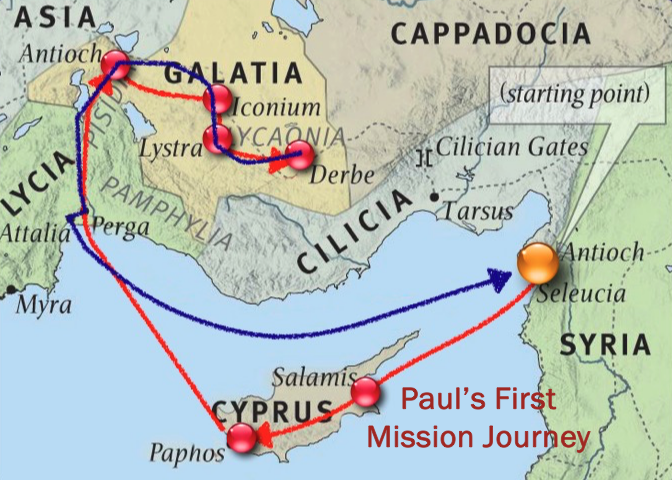
Then Paul and Barnabas, on their first missionary journey, toured the island of Cyprus, which was the home of Barnabas. Barnabas, as you know, was a man full of faith and of the Holy Spirit. His name meant “Son of Encouragement.” He was a mighty man of God, and so, of course, was Saul, later to be called Paul. In Acts 13, they went across the island and eventually came to the leader of the whole island, the proconsul Sergius Paulus, a man of intelligence. He summoned Barnabas and Saul and sought to hear the word of God. But he had a man with him—Elymas the magician (for that is the meaning of his name)—and Elymas opposed Paul and Barnabas, seeking to turn the proconsul away from the faith. Paul turned to him and said, “You son of the devil! You’re going to be struck blind.” And all of a sudden, he was blind and needed someone to lead him around by the hand. At that point, it says, “The proconsul believed, when he saw what had occurred, for he was astonished at the teaching of the Lord” (Acts 13:12). It’s a very high-impact, Spirit-empowered visit to Cyprus.
Turning Antioch upside down
After witnessing and leading this Roman proconsul to faith in Christ on Cyprus and striking this opponent of the gospel blind, the apostles moved on to the city of Antioch in Pisidia. "Many Jews and devout converts to Judaism followed Paul and Barnabas, and the next Sabbath almost the whole city gathered to hear the word of the Lord. And the word of the Lord was spreading throughout the whole region. But the Jews incited the devout women of high standing and the leading men of the city, stirred up persecution against Paul and Barnabas, and drove them out of their district. And the disciples were filled with joy and with the Holy Spirit" (Acts 13:43-52). You see it again—it's spreading like wildfire throughout the whole city and region. Some people get really hot and bothered and angry, and the apostles are driven out. But other disciples remain behind in that city, and their impact continues, and they’re filled with joy.
Turning Iconium upside down
Then they go to the town of Iconium. Acts 14:1-2: "A great number of both Jews and Greeks believed, but an attempt was made by both Gentiles and Jews, with their rulers, to mistreat them and to stone them." So a great number of both Jews and Greeks are coming to the Lord, but others who are leaders among them are ferociously opposed. The apostles didn’t directly attack or say harsh things against the leaders, but the leaders knew that there was a power and a ruler that had come into their town. The disciples kept proclaiming that Jesus is Lord, and this really caused a stir.
Turning Lystra upside down
Then they went to Lystra. While they were preaching and healed someone who had been crippled for a long time, the people of Lystra were amazed. They lifted up their voices, saying in Lycaonian, “The gods have come down to us in the likeness of men!” They thought Barnabas was Zeus, the chief god, and Paul was Hermes, the messenger god. They brought out the priests of the city for these gods to worship Paul and Barnabas. Paul and Barnabas cried out, “Turn from these vain things to the living God!” They said, “We’re not gods—we’re just men like you.” Not long after that, Jews came from Antioch and Iconium. Having persuaded the crowds, they stoned Paul and dragged him out of the city, supposing that he was dead (Acts 14:11-19). One moment they’re being worshiped, the next moment they’re being pelted with rocks meant to kill them. Either way, they’re causing quite a stir. There was something remarkable about the Lord’s presence in Paul and Barnabas, and wherever they went, it amazed people.
So those are some events from Paul and Barnabas’ first missionary journey. They went to Cyprus, then throughout that particular region of what today is called Turkey, and then returned again.
After that, Barnabas went back to Cyprus with his cousin John Mark to do more mission there, and Paul set out on another missionary journey with Silas as his companion. They went back to some of the churches they had planted, and then the Lord led them into Europe through the call of a dream: “Come to Macedonia and help us.” So they went to Macedonia, to its cities, and into the cities of Greece, and then returned again from that second journey.
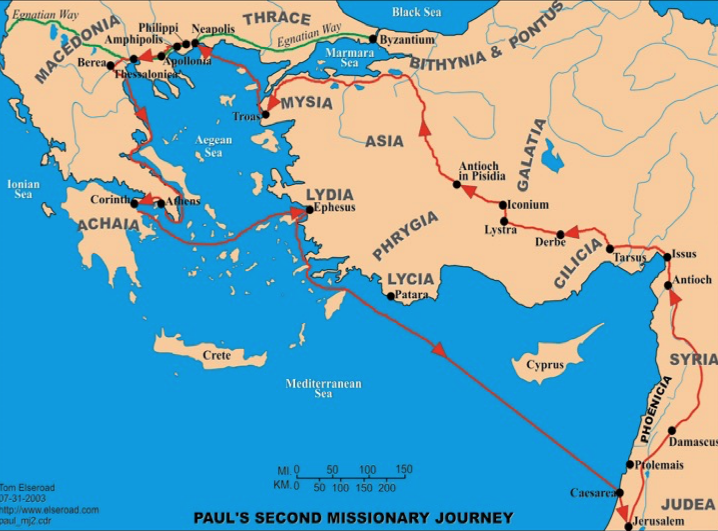
Let's look at some of the places they went on that second journey, and how those cities were turned upside down.
Turning Philippi upside down
They went to the town of Philippi. This was part of Greece. Paul encountered a girl with an evil spirit that had given her the power to be a fortune teller. "Paul said to the spirit, 'I command you in the name of Jesus Christ to come out of her.' And it came out that very hour. But when her owners saw that their hope of gain was gone, they seized Paul and Silas and dragged them into the marketplace before the rulers… they said, “These men are Jews, and they are disturbing our city. They advocate customs that are not lawful for us as Romans to accept or practice” (Acts 16:18-20).
Notice what's really going on here. The girl's slave owners lost some money, so they resort to the old charge that people often use: “These people are not like us.” They use racism and appeal to other people’s racism: “These guys are Jews, and we don’t like Jews, and they’re causing trouble here." Of course, the slave owners themselves are the ones who are really causing the trouble.
Paul and Silas are whipped publicly without any trial, and then they are thrown into a jail. The jailer locks them in painful stocks. Paul and Silas are singing hymns to God and praising him there at midnight. Then comes an earthquake. In this earthquake, all their chains fall off, the prison doors fly open, and the jailer is about to kill himself because he thinks all the prisoners have escaped. Paul says, “No, no, no, don’t do that. We’re still here.” The jailer falls before him and says, “What must I do to be saved?” Paul comes back with this great answer: “Believe in the Lord Jesus, and you will be saved, you and your household” (Acts 16:31). The jailer and his family are saved and are filled with joy because they have come to believe in God.
In short, when the apostles come to Philippi there’s an earthquake, there’s a city in uproar, and the city’s being turned upside down.
Turning Thessalonica upside down
Then they move on to Thessalonica. Later, Paul, in a letter to the Thessalonians, recalls what it was like when they came there. He says, “Our gospel came to you not only in word, but also in power and in the Holy Spirit and with full conviction” (1 Thessalonians 1:5). This made an impact. Some of the people who were welcoming Paul and Silas and letting them stay at their home got into trouble for this.
Some opponents in Thessalonica issued that famous complaint: “These men who have turned the world upside down have come here also... and they are all acting against the decrees of Caesar, saying there is another King, Jesus.” And the people and the city authorities were disturbed (Acts 17:6-7). Every time you say, “Government is not God. Jesus is Lord,” every time you declare the supremacy of Jesus, you turn somebody’s world upside down, and people get disturbed.
Turning Corinth upside down
Then Paul and Silas go to Corinth. There they run up against strong opposition but also lead many to faith in Jesus. "Crispus, the ruler of the synagogue, believed in the Lord, together with his entire household. And many of the Corinthians hearing Paul believed and were baptized" (Acts 18:8). God encouraged Paul to keep going, despite resistance from some. "One night the Lord spoke to Paul in a vision: 'Do not be afraid; keep on speaking, do not be silent. For I am with you, and no one is going to attack and harm you, because I have many people in this city.' And he stayed a year and six months, teaching the word of God among them. But when Gallio was proconsul of Achaia, the Jews made a united attack on Paul and brought him before the tribunal, saying, “This man is persuading people to worship God contrary to the law” (Acts 18:9-13). Gallio dismissed the charges, but the pattern is there over and over: tremendous gospel impact, and then ferocious opposition and charges of upsetting the established order.

Then Paul goes on his third missionary journey, visiting again the places he’s been before, encouraging the saints there, and spending some special time in Ephesus and some other places, where again the Holy Spirit does some amazing things.
Turning Ephesus upside down
What happened with the apostles were in Ephesus? "All the residents of the province of Asia heard the word of the Lord, both Jews and Greeks… fear fell upon them all, and the name of the Lord Jesus was extolled. Also many of those who were now believers came, confessing and divulging their practices. And a number of those who had practiced magic arts brought their books together and burned them in the sight of all. And they counted the value of them and found it came to fifty thousand pieces of silver. So the word of the Lord continued to increase and prevail mightily. (Acts 19:10-20)
Paul is spending extra time in Ephesus, and these are revival conditions, the mighty anointing of the Holy Spirit and people turning away from their old ways. A lot of us may need to ask, “Lord, what would you like us to make a bonfire of? What is it in our life that needs to go up in smoke?” Even if it costs a lot, even if it costs 50,000 pieces of silver, t’s got to go. Because where the Word of the Lord comes, there comes that conviction, and that transformation, and that separation from the things that formerly gripped our hearts and the sins that held us down.
Ephesus obviously is affected by that. The market for magic books dries up. A lot of the chief practitioners have become Christians and are burning their scrolls publicly, telling everybody else, “Get away from this stuff! Don’t follow it anymore.”
Meanwhile, profits plummet in idol factories. “About that time there arose no little disturbance concerning the Way. For a man named Demetrius, a silversmith who made silver shrines of Artemis, brought no little business to the craftsmen.” These he gathered together with the workmen in similar trades and said, 'Men, you know that from this business we have our wealth. And you see and hear that not only in Ephesus but in almost all of Asia this Paul has persuaded and turned away a great many people, saying that gods made with hands are not gods'” (Acts 19:23-26).
This turns Ephesus upside down. If gods made with hands are not gods, where does this leave the guys whose living is made by manufacturing gods with hands and selling these silver statues to the people of the city and to many pilgrims and people visiting the city? Demetrius and his fellow silversmiths are furious, and they start a riot. After a while, the whole city is in a big uproar. Thousands go into the huge amphitheater yelling, "Great is Artemis of the Ephesians." Luke, the writer of Acts, adds, “Most of them did not even know why they were there.” That’s kind of how mobs are, isn’t it? There’s a big hubbub, and they really don’t know what’s going on. They just know that something must be bad. Meanwhile, the people who are really behind the riot are the ones who want money and are upset that they’re not making that money anymore.
Some time ago, I wrote a little poem about this incident:
The Riot
By David Feddes
With
a moan and a groan and a scowl and a growl,
Demetrius
snarled, “Shall we throw in the towel?
We
can’t seem to sell all these idols we’ve made.
The
people won’t buy them. We’re not getting paid.
Our
idols were selling for oodles of money,
But
now we can’t sell them, and that isn’t funny.
Shall
we throw in the towel? No! I say we shall not!”
As
he spoke, his friends’ tempers began to grow hot.
Then
on went Demetrius, madder than ever,
“You
know who’s been wrecking our business endeavor?
This
fellow named Paul!” (All agreed with a nod.)
“This
fellow keeps saying there’s only one God.
He
says Jesus Christ is the one all should trust.
When
folks believe that, they stop buying from us.
It’s
time to do something. It can’t hurt to try it.
Let’s
praise our great goddess and start a great riot.
So
that’s what they did, and they did it quite well,
Those
furious men with a goddess to sell.
They
were stomping and shouting and screaming so loud
That
soon they attracted an oversize crowd
Who
thought yelling in rage seemed the “in” thing to do.
But
why they were there, most of them hadn’t a clue.
Before
long the whole town had become one huge mob.
How
to calm it back down? An impossible job!
For
two hours they screamed, till they barely could croak.
Then
the clerk of the city stood up, and he spoke:
“What’s
all the commotion? We’ve got a great idol.
We
give her devotion. We honor her title.
But
why attack people who’ve done nothing wrong?
Why
stand around squawking so loud and so long?
This
hubbub could get our fine city in trouble.
So
shut your loud mouths, and go home on the double.”
When
idol-makers blow their stack
and try to start a fight,
It
means God’s people are on track;
They’re doing something right.
But
when we worship money, sex,
TVs and sports and song,
Demetrius gets filthy rich.
We’re doing something wrong.
Wherever the apostles went, the merchants of various sinful and worldly endeavors who had been getting rich suddenly got very upset. If we're serving the Lord faithfully, there are going to be people upset with us too.
Turning Jerusalem upside down (again)
When Paul returns from that missionary journey, he ends up in Jerusalem. And Jerusalem is turned upside down once again. The apostle goes to the temple, and some people see him there, and they get furious. They yell, “Men of Israel, help! This is the man who is teaching everyone everywhere against the people and the law and this place…” Then all the city was stirred up, and the people ran together. They seized Paul and dragged him out of the temple, and at once the gates were shut. And as they were seeking to kill him, word came to the tribune of the cohort that all Jerusalem was in confusion (Acts 21:28-31).
Amid the uproar, a Roman commander sends in soldiers to rescue Paul. He asks Paul, “Aren’t you that guy who led 4,000 terrorists in the desert?” (Acts 21:38) And Paul says, “No, no, no—that’s not me.”
But you see again the tremendous, upsetting impact that the gospel is having as it's spreading: the tremendous power of God for salvation, and the ferocious opposition from the kingdoms of this world and from the agents of the evil one.
Turning the world upside down
“These men who have turned the world upside down have come here also... saying that there is another king, Jesus" (Acts 17:6-7). You see why that accusation is such a great summary of what happens in the book of Acts. Jesus endows his people with power, and they announce him as King Jesus—and it upsets things.
Let’s keep in mind that the Holy Spirit who did all of that in the book of Acts is alive and well and powerful, and his arm is still mighty to save. In a Spirit-empowered movement or revival, Christians are so different, so energized, so bold, so committed to King Jesus, that they cause a stir, and they can’t be ignored by the world around them. Revival first empowers believers and really transforms the church and energizes it, makes it holy. Converts are many, changes are amazing, and opposition is often fierce.
We see this again and again in the book of Acts. And if you study carefully the history of the revivals and the movements of God and the mighty works of the Holy Spirit since then, that’s still how it happens. Believers are empowered and purified. Then the Lord brings many more people into the church, and it makes amazing changes in society. That, in turn, stirs things up, and people start complaining about the world being turned upside down.
Great Awakening (1730-1750)
In America, one of the great events that really changed the history of America and made it much more Christian than it otherwise would have been, and brought salvation to many, was the Great Awakening (and later revivals as well). Jonathan Edwards, one of the people God used in the Great Awakening, wrote: “This work of God soon made a glorious alteration in the town; so that in the spring and summer following, anno 1735, the town seemed to be full of the presence of God: it never was so full of love, nor so full of joy; and yet so full of distress as it was then. There were remarkable tokens of God's presence in almost every house. It was a time of joy in families on the account of salvation being brought unto them; parents rejoicing over their children as newborn, and husbands over their wives, and wives over their husbands. God's day was a delight. The congregation was alive in God's service, everyone earnestly intent on the public worship, every hearer eager to drink in the words of the minister as they came from his mouth; the assembly in general were, from time to time, in tears while the Word was preached; some weeping with sorrow and distress, others with joy and love, others with pity and concern for the souls of their neighbors."
The Great Awakening had a tremendous impact not just on that town or on those people, but it spread throughout America. It spread throughout much of England and parts of Europe. And it made an impact on society, as Christians sought to change some of the structures of society. One of the structures they sought to change was the institution of slavery, the buying and selling and owning of other human beings.
An important British official, Lord Melbourne, griped, “Things have come to a pretty pass when religion is allowed to invade the sphere of private life.” He did not want religion to change the way people related to other people or the way slave owners related to their "property," their slaves. He did not want Christianity or religion to be personal in that respect. He didn’t want it to be public in the sense that it changed public structures. He wanted it to be formal and dead, a church building where you show up once in a while in your nice clothes, a place where kings can be ordained and prime ministers can have dignified funerals and the like. That’s what religion is for, but it’s not supposed to actually change your life.
A slave owner at the time said, “Humanity is a private feeling, not a public principle to act upon.” Perish the thought that we’d get rid of the slave trade. Just keep it your religion private.
Have you ever heard that? In my country people say, “You should not allow religion to interfere with things such as abortion, because that’s not a political matter. That’s just a religious and a private feeling, not a public principle.” What about millions of babies who are killed? How is it justified? “We can’t have religion invade private life. You Christians who say that it’s wrong—we can’t listen to you.”
William Wilberforce was a Christian who had been very much affected by the work of revival and the work of the Holy Spirit and by the truth of the Scriptures. He wasn’t a preacher, but he had a sense of God’s calling upon him, and he went into politics. He said, “God Almighty has set before me two great objects: the suppression of the slave trade, and the reformation of manners.” He wanted to stop the slave trade throughout the British Empire. And when he said “reformation of manners,” he did not mean how daintily to put your napkin on the corner of your mouth or which fork to eat with at a fancy dinner. By “manners” he meant moral conduct. He wanted people’s sexual behavior and their treatment of others—slave labor, child labor, and other such things—to be changed, for people to start treating each other as Christians. He wanted Christianity to have an impact on society. That was taking on a huge challenge, when such powerful people did not want Christianity to impact people’s private life and behavior, nor to impact the way public structures were arranged.
One of the great leaders of the First Great Awakening, John Wesley, was still living in the late 1700s. Wesley wrote to Wilberforce: “Unless the divine power has raised you up, I see not how you can go through your glorious enterprise in opposing that execrable villainy, which is the scandal of religion, of England, and of human nature. Unless God has raised you up for this very thing, you will be worn out by the opposition of men and devils. But if God is with you, who can be against you? Are all of them stronger than God? O be not weary of well doing! Go on, in the name of God in the power of His might, till even American slavery (the vilest that ever saw the sun) shall vanish away before it” (John Wesley letter to William Wilberforce, Feb. 24, 1791).
Wilberforce eventually did prevail. It took decades, but finally, through his efforts, slavery and the slave trade were abolished throughout the British Empire. You see, this tremendous force of the Holy Spirit and revival grabbed his heart and made him a follower of Jesus, one who found salvation in Jesus. But it also made him somebody who turned the world upside down and made an impact on society.
God's revival power
Another example: the Welsh Revival of 1904 and 1905 had a tremendous impact in saving people. They were singing, they were praying, and many people who were in the churches were revived and made strong in their faith. Many others were drawn into the churches and saved for the first time. That made an impact wherever these people went. G. Campbell Morgan wrote, “The fire zone is where the meetings are actually held and where you feel the flame that burns. But even when you come out of it [when you come out of those meetings where the revival is so powerful] and go into railway trains or into a shop, a bank, anywhere, men everywhere are talking of God.”
Coal miners’ mules didn’t know what to do anymore, because their owners had stopped swearing at them. The mules were so used to following commands with a bunch of swear words that they didn’t know how to respond. More than 20,000 people were added to the churches in a very short time. There were a number of bankruptcies, mostly bars. A lot of bars and taverns went out of business as that great revival swept across Wales.
We've seen what happened in the book of Acts. And that’s what happens wherever the Holy Spirit continues his work now. “You will receive power when the Holy Spirit comes on you, and you will be my witnesses” (Acts 1:8). You are witnesses of the risen and powerful Lord Jesus Christ. And when you are, you become one of those men or women who "turn the world upside down" wherever you go.
O friend, read that book of Acts, take heart from it, be encouraged by it. Realize that the very same God is at work today. The same mighty Father, the same risen Jesus, the same Holy Spirit who came in such power, that God is still mighty today, and his power is still at work in his world. Let us pray for more and more of that power, that the things he did in the book of Acts may again happen in our time and in our place.
The Book of Acts: Turning the World Upside Down
By David Feddes
Slide Contents
Empowered to witness and turn the world upside down
• You will receive power when the Holy Spirit has come upon you, and you will be my witnesses in Jerusalem and in all Judea and Samaria, and to the end of the earth (Acts 1:8)
• These men who have turned the world upside down have come here also. (17:6)
Turning Jerusalem upside down
At this sound the multitude came together, and they were bewildered, because each one was hearing them speak in his own language. And they were amazed and astonished. (Acts 2:6-7) And awe came upon every soul, and many wonders and signs were being done through the apostles… And the Lord added to their number day by day those who were being saved. (Acts 2:43,47)
Turning Jerusalem upside down
Now when they saw the boldness of Peter and John, and perceived that they were uneducated, common men, they were astonished. And they recognized that they had been with Jesus… “We strictly charged you not to teach in this name, yet here you have filled Jerusalem with your teaching.” … And there arose on that day a great persecution against the church in Jerusalem (Acts 4:13, 5:28, 8:1)
Turning Samaria upside down
Philip went down to the city of Samaria and proclaimed to them the Christ. And the crowds with one accord paid attention to what was being said by Philip when they heard him and saw the signs that he did. For unclean spirits, crying out with a loud voice, came out of many who had them, and many who were paralyzed or lame were healed. So there was much joy in that city. (Acts 8:5-8)
Turning Cyprus upside down
The proconsul, Sergius Paulus, a man of intelligence, … summoned Barnabas and Saul and sought to hear the word of God… But Elymas the magician (for that is the meaning of his name) opposed them, seeking to turn the proconsul away from the faith…. The proconsul believed, when he saw what had occurred, for he was astonished at the teaching of the Lord. (Acts 13:7-12)
Turning Antioch upside down
Many Jews and devout converts to Judaism followed Paul and Barnabas… The next Sabbath almost the whole city gathered to hear the word of the Lord… And the word of the Lord was spreading throughout the whole region. But the Jews incited the devout women of high standing and the leading men of the city, stirred up persecution against Paul and Barnabas, and drove them out of their district… And the disciples were filled with joy and with the Holy Spirit. (Acts 13:7-12)
Turning Iconium upside down
A great number of both Jews and Greeks believed… An attempt was made by both Gentiles and Jews, with their rulers, to mistreat them and to stone them. (Acts 14:1,5)
Turning Lystra upside down
They lifted up their voices, saying in Lycaonian, “The gods have come down to us in the likeness of men!” … Paul and Barnbas cried out, “Turn from these vain things to a living God.”… But Jews came from Antioch and Iconium, and having persuaded the crowds, they stoned Paul and dragged him out of the city, supposing that he was dead. (Acts 14:11-19)
Turning Philippi upside down
Paul… said to the spirit, “I command you in the name of Jesus Christ to come out of her.” And it came out that very hour. But when her owners saw that their hope of gain was gone, they seized Paul and Silas and dragged them into the marketplace before the rulers… they said, “These men are Jews, and they are disturbing our city. They advocate customs that are not lawful for us as Romans to accept or practice.” (Acts 16:18-20)
Turning Thessalonica upside down
Our gospel came to you not only in word, but also in power and in the Holy Spirit and with full conviction. (1 Thessalonians 1:5)
“These men who have turned the world upside down have come here also… and they are all acting against the decrees of Caesar, saying that there is another king, Jesus.” And the people and the city authorities were disturbed. (Acts 17:6-8)
Turning Corinth upside down
Crispus, the ruler of the synagogue, believed in the Lord, together with his entire household. And many of the Corinthians hearing Paul believed and were baptized… And he stayed a year and six months, teaching the word of God among them. But when Gallio was proconsul of Achaia, the Jews made a united attack on Paul and brought him before the tribunal, saying, “This man is persuading people to worship God contrary to the law.” (Acts 18:8-13)
Third Journey of Paul
Turning Ephesus upside down
All the residents of Asia heard the word of the Lord, both Jews and Greeks… fear fell upon them all, and the name of the Lord Jesus was extolled. Also many of those who were now believers came, confessing and divulging their practices. And a number of those who had practiced magic arts brought their books together and burned them in the sight of all. And they counted the value of them and found it came to fifty thousand pieces of silver. So the word of the Lord continued to increase and prevail mightily. (Acts 19:10-20)
Turning Ephesus upside down
About that time there arose no little disturbance concerning the Way. For a man named Demetrius, a silversmith, who made silver shrines of Artemis, brought no little business to the craftsmen. These he gathered together, with the workmen in similar trades, and said, “Men, you know that from this business we have our wealth. And you see and hear that not only in Ephesus but in almost all of Asia this Paul has persuaded and turned away a great many people, saying that gods made with hands are not gods.” (Acts 19:23-26)
The Riot
With a moan and a groan and a scowl and a growl,
Demetrius snarled, “Shall we throw in the towel?
We can’t seem to sell all these idols we’ve made.
The people won’t buy them. We’re not getting paid.
Our idols were selling for oodles of money,
But now we can’t sell them, and that isn’t funny.
Shall we throw in the towel? No! I say we shall not!”
As he spoke, his friends’ tempers began to grow hot.
Then on went Demetrius, madder than ever,
“You know who’s been wrecking our business endeavor?
This fellow named Paul!” (All agreed with a nod.)
“This fellow keeps saying there’s only one God.
He says Jesus Christ is the one all should trust.
When folks believe that, they stop buying from us.
It’s time to do something. It can’t hurt to try it.
Let’s praise our great goddess and start a great riot.
So that’s what they did, and they did it quite well,
Those furious men with a goddess to sell.
They were stomping and shouting and screaming so loud
That soon they attracted an oversize crowd
Who thought yelling rage seemed the “in” thing to do.
But why they were there, most of them hadn’t a clue.
Before long the whole town had become one huge mob.
How to calm it back down? An impossible job!
For two hours they screamed, till they barely could croak.
Then the clerk of the city stood up, and he spoke:
“What’s all the commotion? We’ve got a great idol.
We give her devotion. We honor her title.
But why attack people who’ve done nothing wrong?
Why stand around squawking so loud and so long?
This hubbub could get our fine city in trouble.
So shut your loud mouths, and go home on the double.”
When idol-makers blow their stack
and try to start a fight,
It means God’s people are on track;
They’re doing something right.
But when we worship money, sex,
TVs and sports and song,
Demetrius gets filthy rich.
We’re doing something wrong.
Turning Jerusalem upside down (again)
“Men of Israel, help! This is the man who is teaching everyone everywhere against the people and the law and this place…” Then all the city was stirred up, and the people ran together. They seized Paul and dragged him out of the temple, and at once the gates were shut. And as they were seeking to kill him, word came to the tribune of the cohort that all Jerusalem was in confusion. (Acts 21:28-31)
Turning the world upside down
“These men who have turned the world upside down have come here also… saying that there is another king, Jesus.” (17:6-7)
In a Spirit-empowered movement or revival, Christians are so different, so energized, so bold, so committed to King Jesus, that they cause a stir and can’t be ignored by the world around them. Revival first empowers believers. Converts are many, changes are amazing, and opposition is often fierce.
Great Awakening (1730-1750)
This work of God soon made a glorious alteration in the town; so that in the spring and summer following, anno 1735, the town seemed to be full of the presence of God: it never was so full of love, nor so full of joy; and yet so full of distress as it was then. There were remarkable tokens of God's presence in almost every house. It was a time of joy in families on the account of salvation being brought unto them; parents rejoicing over their children as newborn, and husbands over their wives, and wives over their husbands. (Jonathan Edwards)
God's day was a delight. The congregation was alive in God's service, everyone earnestly intent on the public worship, every hearer eager to drink in the words of the minister as they came from his mouth; the assembly in general were, from time to time, in tears while the Word was preached; some weeping with sorrow and distress, others with joy and love, others with pity and concern for the souls of their neighbors. (Jonathan Edwards)
Religion without impact?
• Lord Melbourne: “Things have come to a pretty pass when religion is allowed to invade the sphere of private life.”
• Slave owner: “Humanity is a private feeling, not a public principle to act upon.”
• William Wilberforce: “God Almighty has set before me two great objects, the suppression of the slave trade and the reformation of manners.”
Go on, in the name of God!
Unless the divine power has raised you up, I see not how you can go through your glorious enterprise in opposing that execrable villainy, which is the scandal of religion, of England, and of human nature. Unless God has raised you up for this very thing, you will be worn out by the opposition of men and devils. But if God is with you, who can be against you? Are all of them stronger than God? O be not weary of well doing! Go on, in the name of God in the power of His might, till even American slavery (the vilest that ever saw the sun) shall vanish away before it.” (John Wesley letter to William Wilberforce, Feb. 24, 1791)
Welsh revival (1904-1905)
“The fire zone is where the meetings are actually held, and where you feel the flame that burns. But even when you come out of it, and go into railway trains, or into a shop, a bank, anywhere, men everywhere are talking of God.” (G. Campbell Morgan)
• Coal miners’ mules didn’t know what to do when commands had no swear words!
• More than 20,000 people were added to churches. Many bars went out of business.
Empowered to witness and turn the world upside down
• You will receive power when the Holy Spirit has come upon you, and you will be my witnesses in Jerusalem and in all Judea and Samaria, and to the end of the earth (Acts 1:8)
• These men who have turned the world upside down have come here also. (17:6)