
Transcript & Slides: The Big Picture
The Big Picture
Romans 1-8
By David Feddes
There are different ways of considering the Word of God. In a sermon series, we look at chunks one at a time and think about them in some depth and see how they apply to our lives. In the same way, you can read the Bible a little bit at a time and meditate on small passages. But there's also reading for the big picture, reading big chunks of the Bible in one sitting. There are sermons that step back and say, "What's going on in the big picture as a whole?" So let's look at these eight chapters of Romans in one swoop.
Called by Christ
The book opens by saying, "Paul, a servant of Christ Jesus, called to be an apostle and set apart for the gospel of God" (Romans 1:1). He was called by God when he was a killer of Christians, and the risen Lord Jesus Christ appeared to him and called him not only to be a follower of Christ, but to be a great missionary of Christ and to spread the gospel. So when Paul speaks of God's grace towards sinners, he is not talking about some doctrine that's way out there. He's talking about something that happened to him, first of all, and what he knows of Christ has flowed out of that call and encounter with Christ.
There were times later on when he was caught up to heaven and saw things he wasn't permitted to tell. The Lord revealed amazing things to him. But it all began when he was called to be a follower of Jesus and a messenger of the Lord Jesus Christ.
Gospel power
Paul wrote this letter to people in Rome, to the capital of the most powerful empire in the world, a mighty city, a glorious city. And in some respects he was a nobody compared to the greatness and power of the emperor. And yet he said, "I am not ashamed of the gospel, because it is the power of God for the salvation of everyone who believes: first for the Jew, then for the Gentile. For in the gospel a righteousness from God is revealed, a righteousness that is by faith from first to last, just as it is written: 'The righteous will live by faith'" (Romans 1:16-17).
The power of Rome was nothing compared to the power of God in the gospel: in the gospel events of Jesus' coming to earth and defeating death, but also in the impact of the gospel in transforming people. The gospel is God's power to save, to bring people from darkness to light, from the power of Satan to God, to give them life everlasting. This is the theme verse of this great epistle: the gospel is God's power for the salvation of everybody who has faith.
Then the apostle begins to expound why we need that gospel.
Available revelation
- Creation displays God’s power and divine nature.
- Conscience gives an inner impression of God’s law.
- Covenant through Moses gives written requirements of God’s law.
- Christ, through his gospel and Spirit, brings forgiveness and eternal life.
There are various ways that God has revealed himself. In creation, what may be known about God is plain to people because God has made it plain to them. For since the creation of the world, the invisible things of God—his eternal power and divine nature—are clearly seen, being seen in the things that are made, so that people are without excuse (Romans 1:19–20). So creation displays God's power and divine nature.
A little later, Paul says your conscience sometimes accuses you and sometimes excuses you (Romans 2:15). You have a conscience that gives you an inner impression of God's law, a sense of what God wants.
Another form of revelation is God's covenant through Moses, the written requirements of God's law. "The person who does these things will live by them" (Leviticus 18:5).
So you have available revelation in creation, in your own conscience, in the law that God revealed to the people of Israel.
And yet those forms of revelation aren't enough. We need Christ, we need the gospel, we need the Holy Spirit, because we need forgiveness and we need eternal life. Creation and conscience and the law of Moses cannot bring forgiveness and salvation. Only the gospel of Jesus Christ has the power to do that.
Three kinds of sinners
- Rebels without restraint (1:18-32)
- Moralism without morality (2:1-16)
- Religion without relationship (2:17-3:8)
With those different forms of revelation, there are different brands of sinners. Paul talks about each of those brands of sinners. Each of us can see something of ourselves, maybe in more than one category.
One kind of sinner is those who have the creation revelation. They have the greatness of God shown to them, but they start worshiping created things rather than the Creator, whether that’s gods they make up, whether that’s chasing whatever their sexual urges might be, whether that’s just being mean to others. The apostle talks about these rebels without restraint, who live wild and wicked lives. That’s one kind of sinner.
Then there is another kind of sinner. They look at the rebels without restraint and say, "Those are bad, bad people. I'm glad I’m not like that. We need more morality in our culture." The apostle says, Yes, you believe in morality, but really you're just moralizing. You're saying that people ought to be good, but are you really so perfect yourself? You condemn others, but how about what you're doing? In the words of Jesus, you're trying to take a speck out of somebody's eye, but that's hard to do when there's a big log sticking out of your own eye. That's moralism without morality: you want God’s law to prevail on other people, but you're not living up to it yourself whenever it seems inconvenient for you.
Conscience alone doesn't save or transform us any more than creation alone does. Those who have only God's revelation in creation become rebels without restraint. Even if you have conscience, people manage to tiptoe around their conscience and apply morality to others rather than looking in the mirror.
Then there are those who have religion without relationship. Maybe they have the law of Moses and the great rituals. And they start counting on the rituals, and they start counting on their deeds. But those things can't save them because they don't have a living relationship with God.
After discussing all this, the apostle says, "What shall we conclude then? Are we any better? Not at all. There is no one who does good, not even one" (Romans 3:9–12).
There are different brands of sinners. If you're in one group rather than another, you might feel superior to those in another group. If you're a rebel without restraint, you say to yourself, "I’m better than those others, because at least I don’t pretend. I’m authentic." You feel superior to all those stuffy religious people. "I stay away from church; they're just a bunch of hypocrites. I'm not a hypocrite. I don't pretend to be pious. I parade my sins openly." Meanwhile, there are people of conscience who have their morals and look down on those who don’t. There are religious people who have their religious practices and rituals and look down on those who don’t.
Devastating diagnosis
Whatever brand of sinner you are, the apostle levels it all and says, "What shall we conclude then? Are we any better? Not at all! … there is no one who does good, not even one" (Romans 3:9-12).
Who is closer to making it to the moon, someone who's in a wheelchair and can't walk and is at sea level, or somebody who is at the top of Mount Everest and is an expert climber? Obviously, the climber can do some things that the person in the wheelchair can't do.
Similarly, there are some people who are a little more moral than other people. But how do they compare from the point of view that matters the most? Is one any closer to God's glory than another?
How does the wheelchair-bound person compare to the great mountain climber? If you're on the moon and you look down at Earth, what's the comparison between the mountain climber and the wheelchair-bound person? The difference is irrelevant. If you want to make the trip from the Earth to the moon, you do not need climbing lessons. You need a rocket.
Similarly, if you want to cover the distance that has arisen between humanity and God, you don't need a few more lessons in how to be a nice person. You need somebody who can cover that distance for you. You need a complete transformation.
All have sinned and fall short. We will always fall short of the glory of God, and our own efforts aren't going to get us there. And it all comes down to this devastating diagnosis: "Now we know that whatever the law says, it says to those who are under the law, so that every mouth may be silenced and the whole world held accountable to God. Therefore no one will be declared righteous in his sight by observing the law; rather, through the law we become conscious of sin" (Romans 3:19-20).
All of God's revelation, whether in creation, conscience, or the law, leaves us without excuse and shows that we are all sinful, utterly unable to save ourselves or attain to the glory of God and eternal life.
Righteousness from God
Then come two great words: BUT NOW. "But now a righteousness from God, apart from law, has been made known, to which the Law and the Prophets testify. This righteousness from God comes through faith in Jesus Christ to all who believe. There is no difference, for all have sinned and fall short of the glory of God, and are justified freely by his grace through the redemption that came by Christ Jesus. God presented him as a sacrifice of atonement [propitiation], through faith in his blood" (Romans 3:21-25)
Redemption is a picture of God purchasing us and rescuing us from bondage, like redemption out of Egypt. Justified means God declares us right with him; we are accepted by him. Atonement/propitiation means that Christ has paid the penalty through his blood. And it’s through faith in that blood that we become right with God. There's tremendous power in Jesus' blood to make us right with God. And that is how God has revealed his righteousness. God did this to show that he’s just—he punished sin. He didn't punish the sins right away when they happened, but he was storing up the punishment, and he laid it all on Christ. He lays all of our sins on Christ. Jesus' blood is the payment. It provides redemption and propitiation and justification, makes us right with God.
Justified by faith: God's plan all along
Then the apostle, in chapter 4, goes on to insist that he's not saying anything brand new. God had been planning this all along. It's part of what he's always said and part of his unfolding plan.
All along God justified the wicked by counting faith as righteousness. Abraham was not called when he was a great all-around guy. He and his family were idol worshipers when God called him. "Abraham believed God, and it was credited to him as righteousness" (Romans 4:3).
All along God chose Abraham to be the father of many nations, not just one nation. It's not a new thing that God wants to bless all nations. God never had only Israel in mind when he chose Abraham. He said, "Through you all nations will be blessed." God has good news for Gentiles. He's always been planning this, and now it's happening: through Christ, the seed of Abraham, all the nations are being blessed.
All along the chosen nation of Israel was meant to bring blessing to all nations. It was not meant to keep God's blessing to itself and be snooty and despise others. If Jews turned into racists who despised other nations, they misunderstood God's intention for Israel, which was to bring blessing to all nations.
All along forgiveness and justification would come through the Son of David, Jesus the Messiah. Paul shows that this was the case with Abraham. He shows it was the case with David himself, who said, "Blessed is he whose transgressions are forgiven, whose sins are covered, whose sin the Lord does not count against him" (Romans 4:7-8, quoting Psalm 32:1–2). So neither Abraham nor David claimed to be right with God based on how good they were. It was always being justified through faith.
"To the man who does not work but trusts God who justifies the wicked, his faith is credited as righteousness… God credits righteousness apart from works… God will credit righteousness to us who believe in him who raised Jesus our Lord from the dead. He was delivered over to death for our sins and was raised to life for our justification" (Romans 4:5-6, 23-25) God has always justified people through faith, accepted them on the basis of their trust in him, not on the basis of how well they have performed and earned his favor.
Benefits of belonging (reconciliation)
"Therefore," writes Paul, "since we have been justified through faith, we have peace with God through our Lord Jesus Christ. By him we have gained access by faith into this grace in which we now stand. And we rejoice in the hope of the glory of God. Not only so, but we also rejoice in our sufferings because we know that suffering produces perseverance, perseverance character, and character hope. And hope does not disappoint us because God has poured out his love into our hearts through the Holy Spirit whom he has given us.
You see, at just the right time, while we were still powerless, Christ died for the ungodly. Very rarely will anyone die for a righteous man, though for a good man someone might possibly dare to die. But God demonstrates his own love for us in this: While we were still sinners, Christ died for us.
Since we have now been justified by his blood, how much more shall we be saved from God's wrath through him? For if, when we were God's enemies, we were reconciled to him through the death of his Son, how much more, having been reconciled, shall we be saved through his life? And not only is this so, but we rejoice in God through our Lord Jesus Christ, through whom we have now received reconciliation. (Romans 5:1-11)
That great passage describes the benefits of being reconciled to God, of belonging to him. You have peace with God. You have God's favor and friendship. You rejoice in the hope of his glory. You rejoice even if you're suffering, because you know God is doing something good in the middle of it, so you're rejoicing in that too. You're flooded by the Holy Spirit. You're sure of God's saving love, and so you have joy in God—not just belief that he exists, not just a desire to do something so you don't get in trouble with him, but you rejoice in God. And you rejoice in God supremely because of his love.
This passage shows the two greatest demonstrations of God's love. One is simply the experience of God's love as he pours his love into our hearts through the Holy Spirit, and we sense deep down that we're loved. The other is the great public demonstration of love: While we were sinners, Christ died for us. The apostle will say more later about the love poured out in the Holy Spirit, and he will say more about God's love in Jesus Christ, from which nothing can separate us. But here he simply states the two greatest revelations of love: God makes it known to you on the inside by his Holy Spirit, and he makes it known to you publicly and objectively on the outside by the death of his Son even while you were still God's enemy.
Remember that this is God the Father's love that's being demonstrated. We should never think, "The Holy Spirit is nice to us and loves us, and Jesus loves us, and it's a good thing because they'll get us off the hook with that grumpy God the Father." No, it all starts with the Father's love. God the Father is the one who gave his Son, and it is the Father's love that pours out the Holy Spirit into our hearts.
Adam and Christ
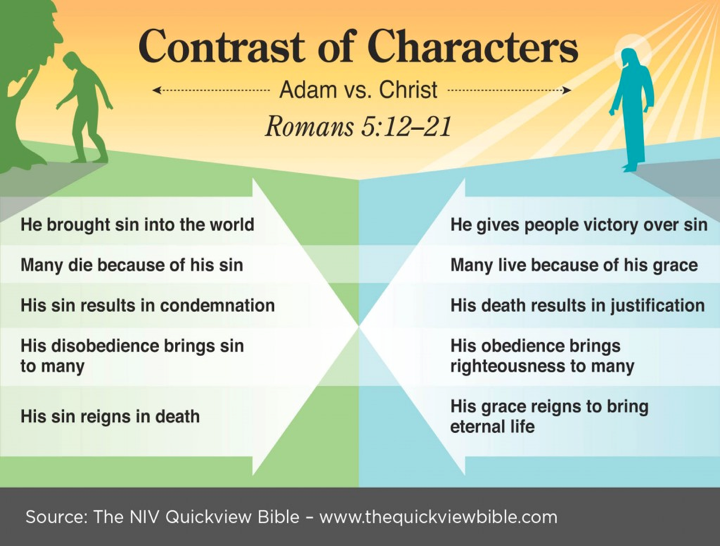
The apostle explains that we are represented and involved with Adam, and we are represented and involved with Christ. When Adam sinned, he brought sin into the world. When Christ obeyed perfectly and gave his life, he gives people victory over sin. Many died because of Adam's sin. Many live because of Christ's grace. Adam's sin brings condemnation. Jesus' death results in justification. Adam's disobedience brings sin to many; if you're involved in Adam, you're involved in his sin. But Jesus' obedience brings righteousness to many, so you're involved in what Jesus has done. Adam's sin reigns in death, but Christ's grace reigns in righteousness to bring eternal life.
Adam and Christ are the two great representatives of humanity. You are in Adam from birth. He represents you. In his sin, you sin. You're at war with God by being involved in Adam. And don't think that you were good but had the misfortune of Adam representing you. You went right along with old Adam by sinning yourself. But if you're represented in Christ, then you have somebody who has made you right with God, and you're involved in him. And everything that involves him involves you too.
Complete in Christ
We're complete in Christ. Salvation equals Jesus plus nothing. Nothing I do makes me right with God. As the apostle says near the end of Romans 5, the result of one act of righteousness was justification that brings life for all men. It was Jesus and his great act of righteousness. So salvation is Jesus plus nothing.
But also remember the other reality: salvation equals Jesus minus nothing. There are some in our time who have said, "You can accept Jesus as Savior but not as Lord. You can get his salvation, but your life might not change at all." There were people in Paul's time who said, "Why don't we just keep on sinning so that grace may abound? If forgiving is God's job anyway, let's give him a job to do. Let's sin. Let's do bad stuff because salvation is Jesus plus nothing." And the apostle says, "Yes, but it's also Jesus minus nothing." Everything Jesus is and everything Jesus does involves me. The whole me is in union with the whole Christ. I can't divide him into being Savior and ruler. I need to take the whole Christ, and he gets the whole me.
Paul describes this union with Christ: legal union and living union. In legal union, Jesus represents us. He's our legal head, and so he acts on our behalf, the way a president can bring his country into a war or refrain from a war. He's involving us and acting on our behalf. What he does is counted by God as ours. So his perfect obedience is credited to us. The blood he shed is credited to us as the full payment for our sins. He's our legal representative. We have this legal union with him.
We also have have a living union with Christ. He lives in us, and we live in him through a living connection. He's our living head, and we're his body. His actions affect and direct our experience, and his death and his resurrection flow into our lives. The apostle speaks of this especially with regard to baptism. What happened to Jesus happens to us. We're in union with him. "We were therefore buried with him through baptism into death in order that, just as Christ was raised from the dead through the glory of the Father, we too may live a new life" (Romans 6:4). When Jesus died, we died. When Jesus was buried, we were buried. When Jesus was raised, we were raised. And this has implications for how we live. We have new life because we’re alive in Christ.
Be your new self
Then we get the first command in the book of Romans: "Count yourselves dead to sin but alive to God in Christ Jesus" (Romans 6:11). The apostle has been writing and speaking of the gospel for many chapters before he ever says anything that you're supposed to do. The gospel is about what God has done in Christ and in his Holy Spirit. And now, what do we do? The first thing to do is count yourself dead to sin and alive to God in Christ Jesus—because you are.
Think of a person who has spent time in prison. After you've spent a long time in prison, you start to think like a prisoner. You worry about what the guards are going to do. You worry about what your fellow prisoners might do. You're quite dependent, and you're not might not be ready to live independently. When the prison door swings open, you're free. The prison guards don't have any authority over you anymore. But if you bump into one in a local coffee shop, you might still feel intimidated. So you have to start thinking like somebody who's free. Don't think like a prisoner anymore, because your not.
Count yourself free, no longer imprisoned in sin, but instead free and alive to God in Christ Jesus. Get out of the prisoner mindset and into the free-person mindset. Be who you now are in Christ. Count yourself dead to sin, alive to God in Christ Jesus.
Sin’s wages vs. God’s gift
If you're tempted to go back to a life of sin, don’t even think about it. "What benefit did you reap at that time from the things you are now ashamed of? Those things result in death. But now that you've been set free from sin and have become slaves to God, the benefit you reap leads to holiness, and the result is eternal life. For the wages of sin is death, but the gift of God is eternal life in Christ Jesus our Lord" (Romans 6:21–23).
Every once in a while, you get tempted to think, “My old life of sin had its advantages.” But what are you forgetting? After God saved the Israelites from slavery in Egypt, there were times when they wanted to go back. They said, "Back in Egypt, the leeks and the onions so tasty.” They remember Egyptian flavors, but they forgot that their babies were being murdered there, that they were slaves, and that the lash of the taskmasters was constantly on them. All they remembered was their stinking onions.
Sometimes that's the way a Christian can be. You think back to the life of sin and one or two things that were fun for you at the time, and you say, “Those might have been the good old days. What if I go back?” The apostle says, “Come on! Think! Your old life if sin was giving you shame, and it was ruining your life. And it was killing you. Sin’s wages is death. God’s gift is life. Keep the gift. Dump the deadly wages."
Free from the law
Then Paul talks about the relation of Christians to the law. The law of God is a good thing. It was given for a definite purpose, but not for the purpose of saving us. We need to be rescued from the law.
One way to think of it is marriage. You're tied to somebody as long as both of you are alive. But if one dies, then you're no longer tied to that person; the marriage has ended because of death. “Likewise, my brothers, you also have died to the law through the body of Christ, so that you may belong to another, to him who has been raised from the dead, in order that we may bear fruit for God” (Romans 7:4). We've been set free from the law so that we can belong to Jesus. We have a new spouse.
If you have a spouse who's perfect, that's not always comforting, especially if he's a perfectionist. You might say, “I wish I had the perfect spouse.” Be careful what you wish for. The law was a perfect spouse in one sense: it was always right. Do you really want to be stuck with someone who's always right and insists that you always be right, but never helps you to improve? That would be a very difficult situation. But that's what the law was like. It was like a perfectionistic spouse who was always right but wouldn't help you to get right.
Like God's law, Jesus is always right. He’s perfect. But unlike God's law, Jesus helps us when we're not perfect. Jesus brings the forgiveness and the grace and the mercy that helps you to really grow and be transformed in your life.
So what does it mean to be released from God’s law? It doesn’t mean that now we can just do bad stuff, or that the law and God’s good will don’t matter anymore. But it does mean this:
- We’re declared righteous apart from law. We are right with God through faith in Jesus, who kept God’s law perfectly on our behalf.
- We are free from the law’s covenant curses, because Jesus suffered the curse and canceled our debt. The law said, “Cursed is everyone who is hung on a tree” (Deuteronomy 21:23). Jesus took that curse on the cross and canceled our debt.
- We are empowered by the Holy Spirit, not by law. We don’t have to change our lives just by trying to obey the law. The Holy Spirit writes God’s law in our hearts, not just on tablets of stone, giving us not just the rules and the guidance, but the desire to obey God and even the ability to obey God more and more. The Spirit is applying the same law of God but now giving us power and ability to keep it.
- The old rituals of the law have been replaced. The Old Covenant signs that God used before Jesus came—the rituals, the sacrifices, the dietary laws, the feast days—those things were pictures pointing to Christ. And now those Old Covenant signs give way to the New Covenant reality of Christ.
We’re released from the law in these senses, not in the sense that God's will doesn’t matter anymore. What God wants matters a lot. But the Holy Spirit is the one who transforms us to live in line with that law.
Dealing with the flesh
There’s an “already” and a “not yet” in the Christian life. Wonderful things have happened, but not everything has happened completely. And one of those things that hasn’t happened completely is the full transformation into the likeness of Jesus.
So you find yourself in that difficult struggle of Romans 7, where you’re doing things you hate, and you're not always doing the things that you really want to do. "For we know that the law is spiritual, but I am of the flesh, sold under sin. For I do not understand my own actions. For I do not do what I want, but I do the very thing I hate. Now if I do what I do not want, I agree with the law, that it is good. So now it is no longer I who do it, but sin that dwells within me (Romans 7:14-17).
Sin still lingers in me, but it's not really me. It's an alien power in me that's trying to ruin me. I need to recognize that fact when I’m struggling with an addiction, whether it’s an addiction to pornography, alcohol, or drugs; whether it’s a addiction to anger or any other habit that has really got a hold on me and that I cannot seem to change successfully. I need to realize that I’m in Christ and that I’m not going to be able to deal with it just on my own energy.
When you have this flesh, this cancerous fallen self, still bothering you, one temptation is to go with self-indulgence: “I’m just going to surrender to the flesh and try to enjoy living in immorality and tell myself that God’s not a factor anyway.”
An opposite reaction is self-improvement, trying to fight the flesh by trying harder to be moral. But if something is really powerful and addicting in your life, you find yourself almost more addicted the harder you try.
You need Spirit-indwelling in order to fight the flesh. Give up on self-indulgence and self-improvement and rely on God’s Holy Spirit. Trust God’s grace in Christ to forgive your sins. That’s one of the first things to release you from an addiction. The more guilty you feel about something and the more ashamed of it you are, ironically, the more likely you are to keep on doing it. It sounds weird, but even if you don’t believe Christian theology, psychology will tell you that the things you are most ashamed of and feel most guilty about are often the hardest things to quit. So one of the first things to break addiction is to know that you are forgiven. It is not held against you. You do not need to feel constant shame and guilt about it anymore. When you accept forgiveness through Christ, you also need to depend on the Spirit's power to defeat the flesh. Somebody is at work in you who is even stronger than your addiction.
When the apostle describes his struggle with the flesh, Paul says, “O wretched man that I am! Who will rescue me from this body of death?" Then he says, "Thanks be to God—through Jesus Christ our Lord!” (Romans 7:24–25). He goes on to say, "There is now no condemnation for those who are in Christ Jesus” (Romans 8:1). The condemnation is gone. So don’t feel guilty and ashamed anymore. And realize who’s at work in you now: God’s Spirit is inside you.
God’s Spirit within us
- Spirit of freedom (8:1-4)
- Spirit of life (8:5-13)
- Spirit of adoption (8:14-17)
- Spirit of expectation (8:18-25)
- Spirit of prayer (8:26-27)
The great theme of Romans 8 is what God’s Spirit does in us. God’s Spirit, the third person of the Holy Trinity, the Helper, the Counselor, was sent by Jesus and the Father from heaven's throne to be with us and to be in us. We see in Romans 8 that he’s the Spirit of freedom, the Spirit of life, the Spirit of adoption or sonship, the Spirit of expectation, and the Spirit of prayer. And in each of these areas we have wonderful blessings from God.
He is the Spirit of freedom. You can't soar in freedom by flapping your own wings. That is not the way to overcome the flesh and the power of sin in your life. "The power of the Spirit of life set me free from the law of sin and death" (Romans 8:2). You need a need law to set you free.
Think of the laws of flight. If you want to fly but only think about how to build a machine where you can flap your wings hard enough to defeat the power of gravity with your own energy, that’s not going to work. You need a different law. How did people finally learn to fly? They found out how the laws of aerodynamics and the laws of combustion in the internal combustion engine could counteract the law of gravity. Airplanes relied on those laws to fly. That's what it’s like when the law of the Holy Spirit sets you free from the law of sin and death. The gravity of sin is overpowered by a new law that’s at work within you. The Spirit of freedom sets you free from the law of sin and death.
He's the Spirit of life. “The mind of the Spirit is life and peace” (Romans 8:6). The Spirit is God's life inside you. "If the Spirit of him who raised Jesus from the dead is living in you, he who raised Christ from the dead will also give life to your mortal bodies through his Spirit, who lives in you” (Romans 8:11). So he’s the Spirit of life in the sense that he transforms your life, but also the Spirit of life in the sense that once he's in you, your body too is going to be raised like Christ’s body has been raised. By the Spirit of life, you kill the deeds of the body and live to Christ. You have abundant life now through the Holy Spirit, and you have resurrection life forever when you're made perfect and your body itself is raised again.
He’s the Spirit of adoption. “You did not receive a spirit that makes you a slave again to fear, but you received the Spirit of adoption (or of sonship). And by him we cry, 'Abba, Father.' The Spirit himself testifies with our spirit that we are God's children. Now if we are children, then we are heirs—heirs of God and co-heirs with Christ” (Romans 8:15–17). The Spirit tells us that we are God's children, and we cry out to him as our Father—our Daddy—who loves us and whom we love.
In the parable of the prodigal son, Jesus speaks of two sons. Neither of the sons knew their father's heart. The younger son wanted his inheritance. He wished his dad were dead so he could have it all. But the dad gave it to him while he was still living. The son took off and blew all the money. He ended up envying the pig slop that the hogs were eating. At that point, he decided, “I'm going to return and go to my father and say, ‘Father, I’ve sinned against heaven and against you. I'm no longer worthy to be your son. Make me one of your slaves.’”
When he gets home, he starts his speech, but he never gets a chance to finish it. He says, “I’m no longer worthy to be your son,” but he doesn’t even get to the part, “Make me your slave,” because his father runs to him, throws his arms around him, and says, “Put the robe on him. Give him the ring that shows he’s a son and one of the heirs of the family.” His father restores him to his position as a son. He wanted to go back as a slave, but his father wouldn’t take him back as a slave. He took him back as a son. You don’t receive the spirit of slavery; you received the Spirit of sonship. You’re children of God.
The older brother also used slave talk. He became furious when the father took the prodigal son back. He said, “All these years I’ve been slaving away for you, and you didn’t even give me a little goat for a feast with my friends. And you give him the fattened calf!” The father replies, “Son, everything I have is yours. You want me to give you a little goat? Don’t you realize everything I have is yours?” The older brother has to stop thinking he's slaving away for his father, and start realizing that he has everything that belongs to his generous father.
God gives us the Spirit of sonship. We cry out, “Abba, Father.” We’re his heirs. We’re fellow heirs with Christ. God loves us with the same love that he has for Christ. That’s what the Bible teaches: he loves us as much as he loves his own Son, and his Spirit tells us so.
So don’t say, “God, I’m going to try to be a better slave from now on,” or, “God, I’m sorry, please take me back as a slave or a hired man,” or, “God, you haven’t been treating me well lately—I wish you’d give me just a little goat so I could have a party once in a while.” Say, “God, I thank you that everything that is yours has been given to me in Christ.”
The Spirit of expectation lives in us. If we're heirs of God and co-heirs with Christ, then we have big expectations. We have the firstfruits of the Spirit, and so we wait eagerly for various things. The apostle says we're waiting for our adoption to be confirmed and the redemption of our bodies—the resurrection of the body—and for us to be publicly declared to be the children of God.
We’re going to enjoy the glory of God’s children when God says, “Well done,” and when God sings over us and rejoices over us, and when all the splendor of the creation is shining from us as well. We look forward to that.
And we look forward not only to ourselves being changed but to something that happens to the whole creation. The entire creation has been groaning, but it's going to be set free from its bondage to decay and brought into the glorious freedom of the children of God. Now we're really getting into the really big picture. Did you think that Jesus was dying just to save you? That is a wonderful thing, and he loves you with a tremendous love. But he has much more planned.
At the end of The Hobbit, Gandalf says to Bilbo, “You are a very fine person, Mr. Baggins, and I am very fond of you; but you are only quite a little fellow in a wide world after all!"
Likewise, God is very fond of each individual, and he is redeeming us one at a time, but he is also redeeming a whole people for himself, and he intends to redeem the whole creation. God appointed humanity to run creation and run it well. Our sin damaged not only humanity but all of creation. When God has fully redeemed his, we’re going to run creation well. The creation itself will be liberated from its bondage to decay. When our bodies are raised glorious, the whole creation is going to be raised glorious, with the people of God in charge.
That day hasn’t yet come. We have the firstfruits of the Spirit. There are some signs of flourishing, some buds, some little flowers here and there of God’s work in our life. But much more needs to happen, because between the time of Jesus’ first coming and his second coming, we have the last days. The new age of eternal life has begun, but not yet fully. The old age has been dealt a very nasty blow, but it’s not yet quite over.
So we live in the overlap of those two eons, those two ages. We’re in the last days. And living in the last days can sometimes be a struggle. The kingdom has come, and yet the kingdom has not come in its fullness. We have victory over Satan, and yet he goes around like a roaring lion—and he’s angrier than ever because he suffered a mortal wound. We’ve been raised with Christ and share in resurrection, but our bodies are not yet raised and perfected. The church is the bride of Christ, but it still has big problems. We have a new status in Christ: we’re justified, we’re adopted, and yet our adoption is not fully made public, and we don't fully shine with the glory of the children of God. We are growing in holiness, but we still do things we hate and don’t do things we know we ought to do. We’re changing, but the change is not complete yet. We have the firstfruits of the Spirit. We have the down payment, not the completeness. The Spirit helps us in our prayer life, and yet a lot of times, we don’t know what to pray for. The Spirit gives great wonders of healing, but not always. When Christ comes again, there will be no limited powers to heal. There will be a total healing of everybody, once and for all, forever. But that day has not arrived yet. Sometimes the Spirit gives us clear guidance. Sometimes we’re perplexed, and we don’t know what the next step is. We encounter God, but not as directly was we will someday. We’ve come to know God, and yet we know in part. We don’t know fully yet as we will in the future, when we’ll know completely. So there’s this already and not yet.
In the middle of this, the creation groans. We who have the firstfruits of the Spirit groan. And the Spirit himself groans. It’s birth pains. When you’re pregnant and in labor, do you have a baby or don’t you? Well, you have a baby… but you don’t; you're expecting a baby. You groan until that child emerges. Likewise, in the groaning of creation, of Christians, of the Spirit himself, we are expecting the fullness that’s coming. The Spirit within is the Spirit of expectation.
He is also the Spirit of prayer. As the Spirit groans, his groans are prayers. “We do not know what we ought to pray for, but the Spirit himself intercedes for us through wordless groans. And he who searches our hearts knows the mind of the Spirit, because the Spirit intercedes for the saints in accordance with God's will” (Romans 8:26-27). Even when you don’t know what you ought to pray for, the Holy Spirit is at work praying for you, Christ is interceding, and the Father knows what you need even before you ask him.
God’s Golden Chain
After showing our sin and what God has done in Christ and in the Holy Spirit, the apostle reminds us of God's eternal plan. You have this tremendous work of the Holy Spirit—of freedom, of life, of adoption, of expectation, of prayer—and this work is going on. But God had a plan before it ever got going.
It was God the Father who started all this. God the Father loved you before the foundation of the world; he foreknew you in the sense of loving you and choosing you in advance. And he predestined you to be conformed to the likeness of his Son, to be like Jesus. And he called you: he opened your heart and enabled you to hear God's voice on the inside. And those he called, he justified, declared right with God. And those he justified, he glorified. Already now you have the Spirit of glory and of grace resting upon you. And that glory will only become greater.
This is God's golden chain that connects us to Christ. We don’t supply a little paper chain to connect us to the might and power of Christ to pull us out of our mess. God made this chain with his own mighty hand, forged in the fires of eternity: from eternity past to eternity present and into eternity in the future.
Already now, we live in light of the eternal. And because God planned all that and has all that in store, you can bank on this: right now God is working all things for good for those who love him and who have been called according to his purpose (Romans 8:28). God has the really big picture in mind, and he is our really big God. And his wisdom and his power had this in mind all along. This is why he’s done what he did in Christ and why he continues to do it through his Holy Spirit—this mighty plan of God.
So do not think only, “Me and Jesus have a little relationship.” It’s wonderful if you have a personal relationship with Jesus. But it’s not going to be a little one, because he’s a big Jesus, with a very big Father and a mighty Holy Spirit. And God has this magnificent eternal plan, and he wants us to know it, so that we will have an expanded view of the greatness and majesty of God, so that we will know who he is. And nothing will intimidate us once we know this God. And nothing will pull us down.
Respond to THIS!
31 What, then, shall we say in response to this? If God is for us, who can be against us? 32 He who did not spare his own Son, but gave him up for us all—how will he not also, along with him, graciously give us all things? 33 Who will bring any charge against those whom God has chosen? It is God who justifies. 34 Who is he that condemns? Christ Jesus, who died—more than that, who was raised to life—is at the right hand of God and is also interceding for us. 35 Who shall separate us from the love of Christ? Shall trouble or hardship or persecution or famine or nakedness or danger or sword? 36 As it is written: “For your sake we face death all day long; we are considered as sheep to be slaughtered.” 37 No, in all these things we are more than conquerors through him who loved us. 38 For I am convinced that neither death nor life, neither angels nor demons, neither the present nor the future, nor any powers, 39 neither height nor depth, nor anything else in all creation, will be able to separate us from the love of God that is in Christ Jesus our Lord. (Romans 8:31–39).
Prayer
We praise you, Lord, for your greatness, for the incredible wisdom that extends from before the foundations of the world on into eternity, for the plan of salvation, for the wonder of your love, for the magnificence of your gospel, for the power of you for our salvation, for the salvation of people of whatever racial background. We praise you, Lord, for this gospel. May we see the big picture and have our minds expanded by it and praise you as the great and glorious God. May the picture of your vastness and wonder shrink our fears, our sins, and all the things that hinder us from being who we were meant to be. As we come to know you better and know your gospel more deeply, may we become more and more like Jesus. In his name we pray. Amen.
The Big Picture
Romans 1-8
By David Feddes
Slide Contents
Respond to THIS!
8:31 What, then, shall we say in response to this?
Called by Christ
1:1 Paul, a servant of Christ Jesus, called to be an apostle and set apart for the gospel of God.
Gospel power
1:16 I am not ashamed of the gospel, because it is the power of God for the salvation of everyone who believes: first for the Jew, then for the Gentile. 17 For in the gospel a righteousness from God is revealed, a righteousness that is by faith from first to last, just as it is written: “The righteous will live by faith.”
Available revelation
- Creation displays God’s power and divine nature.
- Conscience gives an inner impression of God’s law.
- Covenant through Moses gives written requirements of God’s law.
- Christ, through his gospel and Spirit, brings forgiveness and eternal life.
Three kinds of sinners
- Rebels without restraint (1:18-32)
- Moralism without morality (2:1-16)
- Religion without relationship (2:17-3:8)
What shall we conclude then? Are we any better? Not at all! … there is no one who does good, not even one. (3:9-12)
Devastating diagnosis
3:19 Now we know that whatever the law says, it says to those who are under the law, so that every mouth may be silenced and the whole world held accountable to God. 20 Therefore no one will be declared righteous in his sight by observing the law; rather, through the law we become conscious of sin.
Righteousness from God
3:21 But now a righteousness from God, apart from law, has been made known, to which the Law and the Prophets testify. 22 This righteousness from God comes through faith in Jesus Christ to all who believe.
Power in Jesus’ blood
There is no difference, 23 for all have sinned and fall short of the glory of God, 24 and are justified freely by his grace through the redemption that came by Christ Jesus. 25 God presented him as a sacrifice of atonement [propitiation], through faith in his blood.
One God, one plan all along
- All along God justified the wicked by counting faith as righteousness.
- All along God chose Abraham to be father of many nations, not just one nation.
- All along God’s chosen nation was meant to bring blessing to all nations.
- All along forgiveness and justification would come through the Son of David.
Justified through faith
To the man who does not work but trusts God who justifies the wicked, his faith is credited as righteousness… God credits righteousness apart from works… God will credit righteousness to us who believe in him who raised Jesus our Lord from the dead. He was delivered over to death for our sins and was raised to life for our justification. (Romans 4:5-6, 23-25)
Benefits of belonging (reconciliation)
- We have peace with God.
- We stand in God’s favor & friendship.
- We rejoice in the hope of God’s glory.
- We rejoice in sufferings.
- We are flooded by the Spirit.
- We are sure of God’s saving love.
- We rejoice in God through Jesus.
Knowing God’s love
God's love has been poured into our hearts through the Holy Spirit who has been given to us. (Romans 5:5)
God demonstrates his own love for us in this: While we were still sinners, Christ died for us. (Romans 5:8)
Complete in Christ
Salvation = Jesus plus nothing!
Nothing I do makes me right with God.
“The result of one act of righteousness was justification that brings life for all men.” (5:18)
Salvation = Jesus minus nothing!
All that Jesus is and does involves me. The whole me is in union with the whole Christ. I cannot divide Savior from Ruler.
Union With Christ
- Legal union: Jesus represents us. He is our legal head. He acts on our behalf. What he does is counted by God as ours.
- Living union: Jesus lives in us and we in him through a living connection. He is our living head, and we are his body. His actions affect and direct our experience. His death, resurrection, and reign flow into our lives.
6:4 We were therefore buried with him through baptism into death in order that, just as Christ was raised from the dead through the glory of the Father, we too may live a new life.
6:11 Count yourselves dead to sin but alive to God in Christ Jesus.
Sin’s wages vs. God’s gift
6:21 What benefit did you reap at that time from the things you are now ashamed of? Those things result in death! 22 But now that you have been set free from sin and have become slaves to God, the benefit you reap leads to holiness, and the result is eternal life. 23 For the wages of sin is death, but the gift of God is eternal life in Christ Jesus our Lord.
Free from the law
7:4 Likewise, my brothers, you also have died to the law through the body of Christ, so that you may belong to another, to him who has been raised from the dead, in order that we may bear fruit for God.
Released from the law
- Declared righteous apart from law: We are right with God through faith in Jesus, who perfectly kept God’s law on our behalf.
- Free from law’s covenant curses: Jesus suffered the curse and canceled our debt.
- Empowered by Spirit, not law: The Holy Spirit writes God’s law on our heart, giving us the desire and the ability to obey.
- Old rituals replaced: Old Covenant signs give way to New Covenant reality of Christ.
Doing what I hate
7:14 For we know that the law is spiritual, but I am of the flesh, sold under sin.
15 For I do not understand my own actions. For I do not do what I want, but I do the very thing I hate. 16 Now if I do what I do not want, I agree with the law, that it is good. 17 So now it is no longer I who do it, but sin that dwells within me.
Dealing with the flesh
- Self-indulgence: Surrender to the flesh and try to enjoy being immoral (lawless).
- Self-improvement: Fight the flesh by trying harder to become moral (law).
- Spirit-indwelling: Trust God’s grace in Christ to forgive you and depend on the Spirit’s power to defeat the flesh.
8:1 Therefore, there is now no condemnation for those who are in Christ Jesus.
God’s Spirit within us
- Spirit of freedom (8:1-4)
- Spirit of life (8:5-13)
- Spirit of adoption (8:14-17)
- Spirit of expectation (8:18-25)
- Spirit of prayer (8:26-27)
Spirit of life
- Spirit’s mind is life and peace
- Spirit is God’s life inside you
- Spirit will raise bodies to life
- By the Spirit, kill the deeds of the body, and you will live: abundant life now, resurrection life forever.
Spirit of expectation
Now if we are children, then we are heirs—heirs of God and co-heirs with Christ… We ourselves, who have the first fruits of the Spirit… wait eagerly…
- Adoption confirmed, bodies redeemed
- Glory and freedom of God’s children
- Creation flourishing, free from decay
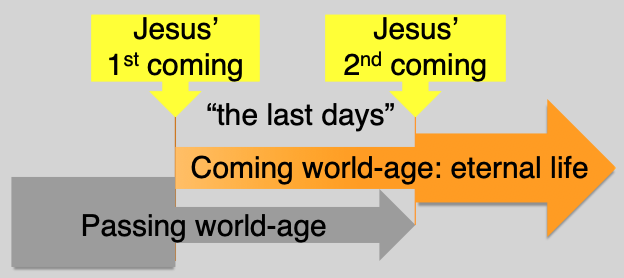
NT speaks of two world-ages (aions). These overlap between Jesus’ first and second coming. God’s kingdom is “already/not yet.”
Already But Not Yet
- Kingdom
- Victory
- Resurrection
- Church
- Status
- Holiness
- Prayer
- Healing
- Guidance
- Encounter
Groaning together
- The whole creation has been groaning as in the pains of childbirth. (8:22)
- We ourselves, who have the first fruits of the Spirit, groan inwardly. (8:23)
- The Spirit himself intercedes for us with groans that words cannot express. (8:26)
Creation groans. We groan within creation. The Holy Spirit groans within us.
Spirit of prayer
And he who searches our hearts knows the mind of the Spirit, because the Spirit intercedes for the saints in accordance with God's will. (Romans 8:27)
God’s Spirit within us
- Spirit of freedom (8:1-4)
- Spirit of life (8:5-13)
- Spirit of adoption (8:14-17)
- Spirit of expectation (8:18-25)
- Spirit of prayer (8:26-27)
God’s Golden Chain
- Foreknew
- Predestined
- Called
- Justified
- Glorified
And we know that in all things God works for the good of those who love him, who have been called according to his purpose.
Respond to THIS!
8:31 What, then, shall we say in response to this?