
Transcript & Slides: Millennium
Millennium
By David Feddes
Today we’re going to be reading Revelation 20:1-6 and reflecting on the millennium. Now, some of you may say, “Millennium? What is that?” and you say, “Oh yeah, that was the name of Han Solo’s spaceship, you know, the Millennium Falcon,” and that’s about as familiar with “millennium” as you are. But “millennium” is a big word that simply means a thousand years. This is the only passage in the Bible that speaks of a thousand-year reign, and we’re going to listen to that passage today.
1 And I saw an angel coming down out of heaven, having the key to the Abyss and holding in his hand a great chain. 2 He seized the dragon, that ancient serpent, who is the devil, or Satan, and bound him for a thousand years. 3 He threw him into the Abyss, and locked and sealed it over him, to keep him from deceiving the nations anymore until the thousand years were ended. After that, he must be set free for a short time.
4 I saw thrones on which were seated those who had been given authority to judge. And I saw the souls of those who had been beheaded because of their testimony about Jesus and because of the word of God. They had not worshiped the beast or its image and had not received its mark on their foreheads or their hands. They came to life and reigned with Christ a thousand years. 5 (The rest of the dead did not come to life until the thousand years were ended.) This is the first resurrection. 6 Blessed and holy are those who share in the first resurrection. The second death has no power over them, but they will be priests of God and of Christ and will reign with him for a thousand years. (Revelation 20:1-6)
Millennium is now
- Millennium = “last days,” the period between Jesus 1st and 2nd comings.
- Jesus’ kingdom reign has already begun.
- Satan is already bound and cast down.
- Millions have already refused the beast.
- “First resurrection” has already happened for souls who reign with Christ in heaven.
As we think about the millennium, I’m going to take the position that the millennium is now. The millennium is the same as the period that the Bible often calls the last days—that is, the period between Jesus’ first coming and Jesus’ second coming. That means Jesus’ kingdom reign has already begun. It’s not yet here in its fullness and in its final, complete form, but his reign has already begun. Satan is already bound and cast down. Millions have already refused the beast. The first resurrection has already happened for souls who reign with Christ in heaven.
Now, that’s what we’re going to be thinking about today, and right away some of you have things coming into your mind: “So how in the world can he say that? If the millennium is the period between Jesus’ first and second coming, my math isn’t great, but I can count to two thousand, and I know it’s more than one thousand. Revelation 20 says a thousand years, and if it’s supposed to be the time between the two comings, how in the world can you say that one thousand equals two thousand? Weren’t you a former math major?” Yes, I was, and no, I don’t think that one thousand is exactly equal to two thousand. But I do believe that the book of Revelation is a book filled with symbols.
I’ll just take a few examples. I do not believe that Satan is a dragon with seven heads. I believe that the picture of a dragon with seven heads shows us important things about Satan, but I don’t think he’s a red critter with seven heads. And I don’t think the locking up of Satan is something you can do with a literal iron chain and slam a lid on a pit. Revelation is using pictures to show things that go beyond what can be pictured. Jesus is not a lamb with seven horns and seven eyes, but Revelation pictures him that way, but it's not literal. The symbolic picture shows important things about Jesus' power and his all-seeing knowledge and the work of his Holy Spirit. Likewise, I don’t believe the Holy Spirit is seven candles sitting before a throne, but he's pictured that way.
The book of Revelation is a book full of symbols. So if I say I don't think that in Revelation a thousand years means exactly and precisely 1,000 years if you count it on the calendar, don’t accuse me of being a heretic. There's a lot in Revelation that is not literal but symbolic. In fact, this is the primary mode of revealing things in Revelation. It uses symbols and pictures to convey great realities.
You might say, “How in the world can you say Jesus’ kingdom reign has already begun? Have you looked around lately? Does it look like he’s reigning?” You might also object, “How can you say Satan is already bound, already cast down, already locked up? He’s all over the place doing all kinds of damage. What lunatic would say that Satan is bound already?” And as for the beast, “Isn’t he that terrible figure that comes at the very end of time? How is it possible to say that millions have already refused the beast?”
If you have heard my previous messages on Revelation, you might remember that there are multiple fulfillments in the Scripture. Just because somebody isn’t the final beast doesn’t mean they haven’t been exercising the power of the beast in earlier eras. The Roman Caesars—Nero, Domitian, other Caesars who persecuted the church in terrible ways and tried to destroy it—were taking beastly actions. So the beast comes in his preliminary forms and then in his final form at the very end of history. But millions have already rejected the beast and remained loyal to Christ.
And the first resurrection has already happened for souls who reign with Christ in heaven. These believers have gone to be with Jesus and have left their bodies behind until the final resurrection happens. But their souls are with Christ, and not only are they communicating with Christ, they are reigning with him.
When I talk about the millennium, I know that fellow believers with some different viewpoints are going to say: “Your view that the millennium is now seems very far-fetched.” We've seen some of the reasons they might say this: they take the thousand years literally, the world looks to them like Jesus isn’t running it, it appears that Satan has an awful lot of power, and they don't see how the first resurrection has happened to any believers.
Let me say, before we dig deeper, that the view I’m presenting is the view that has been held by the most Christians in the most places for the most years of Christian history. It may come as a shock to some Christian friends who’ve grown up in America in recent decades. The view that's predominant in some of the books that get written nowadays is not necessarily the view that all Christians everywhere have always held. But let’s look at some details. It’s easy to say, “This is what I think Revelation 20:1-6 means.” But we also need to get into why we think that’s what it means.
Jesus reigns now
Why would we think that Jesus reigns now? Because he said so! Is that a good reason? “The time has come. The kingdom of God has come near. Repent and believe the good news.” That is the message Jesus came preaching (Mark 1:15). The kingdom has shown up in the showing up of Jesus. “If I drive out demons by the finger of God, then the kingdom of God has come upon you” (Luke 11:20). “The kingdom of God is in your midst” (Luke 17:21). Why do I believe that Jesus reigns now? Because he showed up, and he says so.
“All authority in heaven and on earth has been given to me.” That sounds like someone who reigns now. These are the final words that Jesus spoke in giving the Great Commission before he ascended back to heaven: “All authority in heaven and on earth has been given to me. Therefore go and make disciples of all nations... and surely I am with you always, to the very end of the age” (Matthew 28:18–20).
In the book of Revelation, what does Jesus say? The book opens by giving that great benediction: “Grace and peace to you from him who is, and who was, and who is to come, and from the seven spirits before his throne, and from Jesus Christ, who is the faithful witness, the firstborn from the dead, and the ruler of the kings of the earth” (Revelation 1:4–5). This is who Jesus Christ is right now—the ruler of the kings of the earth. He says, “Don’t be afraid. I am the First and the Last. I am the Living One; I was dead, and behold I am alive forever and ever! And I hold the keys of death and Hades” (Revelation 1:17–18). Not, “Maybe someday I’ll have a shot at holding the keys.” He says, “I hold the keys of death and Hades.”
In the great visions of Revelation 5 and 6, you see the Lamb. And where is he located? At the center of the throne. You’re not at the center of God’s throne if you’re not reigning. Jesus is at the center of the throne. In fact, he’s the one who opens every one of the seals that unfolds the scroll of the rest of Earth's history.
So, whatever our notions about the millennium or what the thousand years represent, I think it’s almost impossible to argue that Jesus is not already reigning if you’re simply taking what Scripture says on the matter. It says he’s reigning.
Satan is bound
Now let’s think about the next thing that might be a little hard to grasp: Satan is bound. Why would I believe that? First of all, because Jesus says so—and the Bible says so, which is the same level of authority. If the Bible says it, then Jesus says it. But we also have quotes from Jesus in the Bible saying it.
“But if it is by the Spirit of God that I cast out demons, then the kingdom of God has come upon you” (Matthew 12:28). “Or how can someone enter a strong man’s house and plunder his goods unless he first binds the strong man?” (Matthew 12:29). What is Jesus talking about? Binding the bully—binding Satan. He’s saying that as he casts out demons, the kingdom of Jesus comes, and Satan gets bound.
The Bible speaks in a couple of other passages about where the demons are right now, or what their condition is. “God did not spare angels when they sinned, but sent them to hell, putting them in chains of darkness to be held for judgment” (2 Peter 2:4). “These he has kept in darkness, bound with everlasting chains for judgment on the great day” (Jude 6). So Revelation 20 is not the only passage in the Bible that speaks of chains and a binding of Satan and his demons. These passages, which are not highly symbolic and are more straightforward, say that the demons are bound and held for judgment.
Whenever we read this passage in Revelation, we need to read it along with other passages: “I saw an angel coming down out of heaven, having the key to the Abyss and holding in his hand a great chain. He seized the dragon, that ancient serpent, who is the devil, or Satan, and bound him for a thousand years” (Revelation 20:1–2). This is what Jesus was talking about when he said, “I’m binding the strong man,” and what the other Scriptures describe when they say that the demons and Satan are bound and limited.
Now, that still requires some thinking. If Satan is bound, how do we put this fact together with other Scriptures that say the devil is “on the rampage like a roaring lion looking for someone to devour” (1 Peter 5:8)? Whatever we mean by the binding of Satan, we don’t mean that he and his demons are totally ineffective and have no impact on the world now. Whatever we mean by the rule of Jesus, we don’t mean that earth is now what it’s meant to be when his kingdom comes in its fullness. There is an “already” and a “not yet” to the coming of Jesus, to his reigning, and to the binding of Satan—and we’ll think about that more as we move along.
When we think of Satan being bound, we also ask, what does it mean to say he’s cast down or cast out? Back to the words of Jesus: “Now is the judgment of this world; now will the ruler of this world be cast out. And I, when I am lifted up from the earth, will draw all people to myself” (John 12:31–32). Jesus is describing what’s going to happen as a result of going to the cross—the casting out of the ruler of this world. For those of you who are fans of Greek, “cast out” here is the same Greek root as casting Satan into the pit in Revelation 20:3. “He threw him into the Abyss and locked and sealed it over him, to keep him from deceiving the nations anymore until the thousand years were ended. After that he must be set free for a short time” (Revelation 20:3).
What does it mean that Satan is in the pit and locked up? It means, for one thing, that he’s already under God’s judgment and that God is already inflicting a level of punishment on Satan and the demons. It’s not yet the final punishment of being cast into the lake of fire that never ends, but it is a punishment.
In terms of him being locked up, it means he’s being limited. It means he’s not able to do all that he would like to do. Satan is limited in two key ways. One is that he cannot cause God’s chosen—God’s elect—to perish. God sets a limit so that those who trust in Christ and belong to Christ cannot be snatched from his hand. Jesus says, “No one can snatch them out of my Father’s hand… no one can snatch them out of my hand” (John 10:28–29). That “no one” includes the devil. Satan and his demons cannot snatch you out of God’s hand when you are a believer, because Satan is limited by God's chain: “Thus far and no further. You cannot take my chosen ones out of my hand.”
A second major limit is that Satan can’t cause a global assault on the church. God limits him to "keep him from deceiving the nations." This doesn’t mean that nobody in any nation is ever fooled, tempted, or tricked by Satan or misled. It does mean that nations as a whole are no longer just locked in darkness and bound over to being without God.
Much of the Old Testament describes peoples who have no clue about God. They’re worshiping this god and that god, which the Bible says is actually the worship of demons (Deuteronomy 32:17; Psalm 106:37). They’re trapped in that. But when Christ comes, Satan’s power to deceive all those nations is severely limited. The gospel begins spreading among the nations, and people who are of non-Jewish background are coming to the Lord and coming to know Jesus Christ—not just people from Israel anymore, but Jesus is a light to all the nations.
Satan would love to put a stop to that. He would love to keep all the nations fooled. He would like to coordinate them all in one vast global assault on the church. But he can’t do it. He can’t. Something is holding him back—God and the power of God. God’s chain is holding him back.
So what Satan would love to do, he can’t do until the very end, when that last restraint is released. We’ll see more about that in a future message. When the end has almost come, Satan will be loosed and will get the nations worldwide to go along with him in one last coordinated assault. Jesus releases Satan to take his best shot, but his best shot doesn’t go very well. Christ triumphs easily by the breath of his mouth. When Satan and all his allies amass their power, Jesus merely needs to breathe to blow them all away.
At any rate, what this means for our own time is that Satan is not nearly as free as he would like to be. His full power is not unleashed on us. We need to realize that. Don’t ever say, “The devil made me do it.” He didn’t. He can fool you, pressure you, tempt you. But when you belong to Christ, he cannot overpower you. The devil can't make you do anything unless you choose to do it. “The one who is in you is greater than the one who is in the world” (1 John 4:4). You need to know that Satan is bound and that he cannot do more to you than God allows him—but more than that, he cannot do more than you allow him, because you have the power and the authority of Jesus Christ, the one who reigns. Jesus has already bound that bully. He’s already cast him down. The only way Satan can get you is by fooling you—he cannot overpower you, because you have a greater power.
It's okay if we don't all hold the exact same position on what the thousand years means. You can disagree about the meaning of the thousand years, but please don’t disagree about this: Jesus reigns now, and Satan is bound and limited now. Nail those things down. Then we can talk a little more about the thousand years. If you thought it was ridiculous to say Satan is limited or that Jesus is reigning, get over it. You need to believe by faith that Jesus is reigning and live by his reign, and by his power, and in his victory. Sometimes that victory might mean dying for the faith. The Bible says, “They overcame him by the blood of the Lamb and by the word of their testimony; they did not love their lives so much as to shrink from death” (Revelation 12:11). Satan can kill you, but he can’t defeat you. Jesus’ limits on Satan might include Satan having a persecutor murder you, but that is not defeat. As we’re going to see, that’s victory—you just got promoted.
Jesus reigns, and Satan is locked up. Those are a couple of things I'm saying about the millennium—that period between Jesus’ first and second comings. I take it to be a long period—that’s what I think the thousand represents. Jesus’ reign has begun. Satan’s already bound and cast down.
In a few moments, we’ll look a little more at what it means that millions have already refused the beast and that the first resurrection has already happened. But first, let’s take a breath and acknowledge that there are different views of the millennium. Bible-believing Christians don’t all hold the same view.
Millennial views
- Premillennial: Jesus returns before; millennium lasts exactly 1,000 years
- Postmillennial: Jesus returns after; millennium is a figurative period of time
- Amillennial: Jesus returns after; millennium is now, between comings
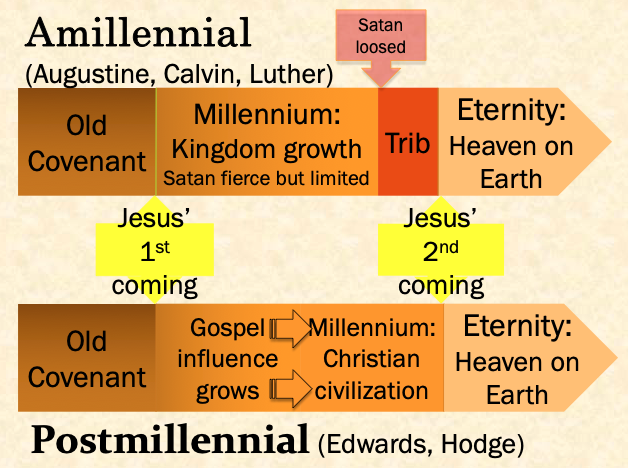
The view I’ve described is the view held by the most Christians for the most time throughout history, but that doesn’t mean they are right or that somebody who has a different perspective is a heretic or completely misguided. The three main views are described as premillennial, postmillennial, amillennial. Amillennial and postmillennial have a very similar view that the millennium is a figurative period of time.
“Pre” means before, so if you’re a premillennial Christian, you believe that Jesus returns before the millennium, and then the millennium lasts a literal one thousand years. Christ reigns on earth with his saints who return with him, and he rules over the nations. Then, at the end of that thousand years of Jesus being visibly and physically present on earth and reigning, Satan manages to deceive the nations after that thousand years of Jesus being physically present on earth, ruling in power and perfection with his saints, and somehow others on earth still find it in them, with Satan’s coordination, to rebel against Jesus. That’s what the premillennial view entails, that after a thousand years of Jesus reigning here on this earth, somehow the nations of the earth are still going to all turn against him. I don’t believe that, but there are Christians—and going back to Christians as great as Irenaeus and Justin Martyr; maybe you’re not a buff in church history, but those are some pretty big names—and they were premillennial Christians. I’m acknowledging there are some very great Christians. When a guy is named Justin Martyr, you don’t take lightly what he says, because he was a great thinker and he died for the faith, and he was a premillennial Christian.
"Post" means after. Postmillennial believers think that Jesus returns after the millennium has occurred. For most postmillennialists, the millennium is a figurative period of time when the gospel has a huge influence on the nations and the world becomes a much better place for a major period before Jesus returns.
Amillennial is also postmillennial in the sense that Jesus returns after the millennium, but amillennial literally means "no millennium." That’s not quite an accurate label. Rather than “no millennium,” I would say it’s “now millennium.” Now is the millennium. Jesus returns after the millennium, and the millennium is that period between Jesus' first coming and his second coming. If you’re thinking about amillennial and postmillennial, they both believe that Jesus comes after the thousand-year period, the figurative thousand-year period, has ended.
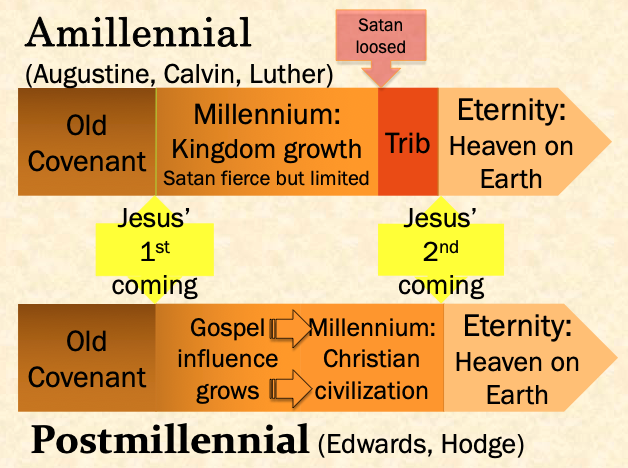
The amillennial view, which I hold, is the view that was held by Augustine, Calvin, and Luther. Those names carry a lot of weight. Amillennialists believe that there was the old covenant period of biblical history. Then, with Jesus’ first coming, his reign on earth begins, and the kingdom grows. Satan’s activity is fierce but limited. Then, near the very end of that period between the two comings, Satan is loosed, and the tribulation, which has been going on to some degree throughout that period, becomes far more intense at the very end. Then Jesus’ second coming puts an end to all that. Heaven comes to earth, and we enter into the life of the eternal realm of heaven on earth. So there isn’t a thousand-year reign and then a rebellion by Satan at the end of the thousand years, as premillennialists think.
The postmillennial view is similar to the amillennial in some key ways, but postmillennialists believe there’s going to be a golden age on earth, that with the influence of the gospel eventually earth will largely be Christianized. Then, almost as the frosting on the cake after Jesus’ invisible reign on earth has become so wonderful and so close to what it needs to be already, Jesus will return. The golden age of Christ’s reign and the nations recognizing it and Christian civilization flourishing will culminate in Jesus coming and bringing eternity to earth. Some great Christians—mostly Americans—were or are postmillennial: Jonathan Edwards, Charles Hodge, and others.
It's worth noting that postmillennialism usually has its greatest attraction and makes the most sense to people when things are going well. When you’re Jonathan Edwards and there is a Great Awakening going on and a tremendous revival, and people are flocking to Christ, and every part of society is being influenced by this tremendous spiritual awakening, you’re saying, "Yes! The kingdom is advancing rapidly and wonderfully. Satan is being put to flight. Not long now and we’re going to see America what it ought to be, and Jesus coming again." That kind of thinking makes more sense than when it appears that the churches are shrinking, that they’re struggling, when Satan’s activity seems fiercer.
The premillennial view that I mentioned earlier has a variant called dispensationalism. This first came along in the mid-1800s. Dispensationalism not only believes in a literal thousand-year reign of Christ but in a secret rapture where a lot of people vanish. Those who left behind wonder what happened and how so many people vanished. There’s a whole scenario that goes along with all of that that. Dispensationalism is a largely British and American phenomenon of the last 150 years, and has spread to other countries mainly by recent American influence. I’m not saying it’s false just because it's a fairly recent interpretation, but I tend to gravitate toward views that most Christians in most eras of the church have held to.
That’s just a little background. Let me say, our church doesn’t require any of these views as the orthodox way to think about the millennium. There are a variety of views on the millennium. That doesn’t mean they’re all correct, but it does mean you need a sense of proportion. Some things matter more than others. On some matters Christians agree to disagree because we haven’t come to a complete agreement on what the Bible is teaching about a particular area.
Even when you don’t reach full agreement, there are good things to be learned. One is, don’t make everything matter the same amount. Not every conviction is as important as the next one. Here's another lesson: learn how to get along with people who don’t see exactly as you do on a variety of matters. At any rate, there are different views of the millennium. Amid the differences, I hope we can agree that Jesus reigns and Satan is limited. I think those are givens that we should accept, whatever else we might differ about.
Interpreting
- Scripture interprets Scripture
- Clear before difficult
- Literal before figurative
- Big picture before details
How do you approach the Bible in the first place? Scripture interprets Scripture. I mentioned that before as a major principle. The book of Revelation has 404 verses, over 270 references to the Old Testament, over 500 indirect allusions to the Old Testament, so you have to pay attention to what the other Bible passages say.
When you’re letting Scripture interpret Scripture, here are some rules of thumb. Generally, take the clearer passages to help you understand what the difficult ones are saying. Generally, let the more literal passages give you some clues to what the more figurative passages are hinting at by their use of symbols and pictures. And get the big picture before you try to fill in every little detail, so that you have a sense of what the big scene looks like.
What’s the big picture? Well, here's the message of Revelation in four words: Jesus wins! Satan loses. Many things in Revelation might puzzle you, but it’s pretty hard to think that Revelation means Satan wins and Jesus loses. No! Jesus wins, Satan loses. Keep that in mind all the time. That is the really big picture.
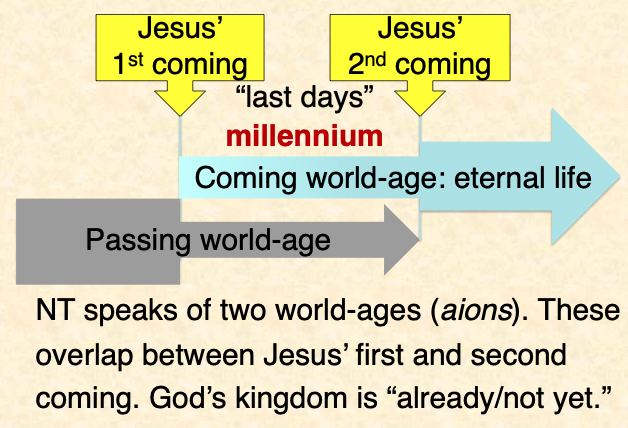
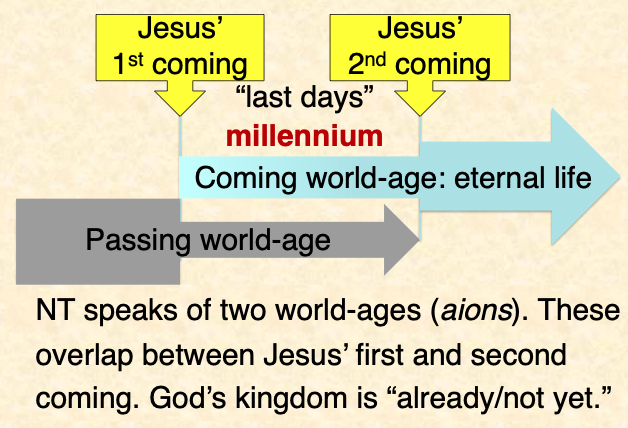
As we get the big picture and fine-tune it, the New Testament has a framework. It speaks of two world ages, or eons. These two eras overlap between Jesus’ first coming and Jesus’ second coming. In other words, God’s kingdom is “already but not yet.” Satan’s binding is “already but not yet.” Jesus’ reign is “already but not yet.”
This “already but not yet” era, where the two ages overlap—the coming world age where Jesus starts a brand-new world—is launched at his first coming and reaches its fulfillment at his second coming. That is the world age of eternal life. The passing world age was very dominant before Jesus’ coming. With his coming, it takes a severe blow and is very limited, but it still continues until Jesus’ second coming. So we’re living in the overlap of those two ages, and that overlapping age is often referred to as “the last days.”
Again, I won’t repeat my case that the last days extend from Jesus’ first coming to his second, because if you don’t already get that from what I’ve said before, then I probably shouldn’t repeat it—but these are the last days. “This is the last hour.” That kind of language is all through the New Testament.
That's the big-picture perspective about time when you think about the New Testament and Revelation.
When you look at kinds of writing in the Bible, there are different kinds. As I said before, you want to take the ones that are more straightforward or easier to understand before the ones that are harder to understand, and see if they help you make sense of the others.
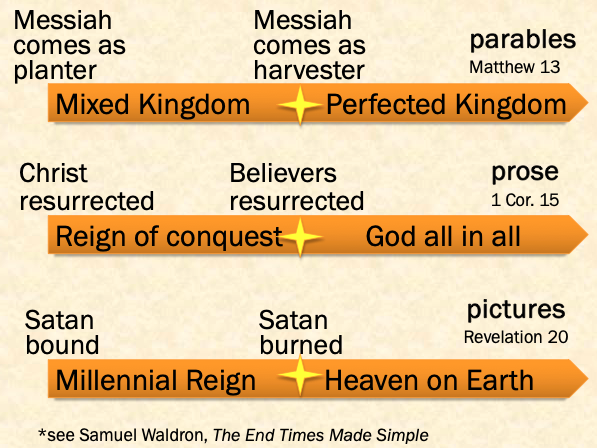
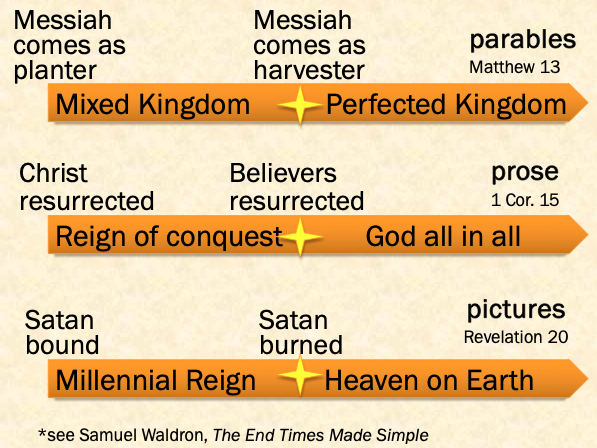
Then you have the writings of the apostles in their letters. To take just one portion of Paul’s writings, in 1 Corinthians 15 he speaks of Jesus’ resurrection coming first and then later on the resurrection of believers. He speaks of a reign of conquest and then a period when God is all in all. “For as in Adam all die, so in Christ all will be made alive. But each in his own turn: Christ the firstfruits; then, when he comes, those who belong to him. Then the end will come, when he hands over the kingdom to God the Father after he has destroyed all dominion, authority, and power. For he must reign until he has put all his enemies under his feet. The last enemy to be destroyed is death” (1 Corinthians 15:22–26).
Jesus must reign until he has put all his enemies under his feet. That’s the reign of conquest. The last enemy to be destroyed is death. Then he will hand the kingdom over to God the Father. “When he has done this, then the Son himself will be made subject to him who put everything under him, so that God may be all in all” (1 Corinthians 15:28). That’s the final state of the kingdom, where God is all in all, and everything on earth and everything in heaven is perfectly attuned to God’s will.
Revelation communicates through a different style of writing—in visionary pictures that God reveals. Not Jesus’ teaching in parables, not letter writing, but symbolic pictures. Here you have Satan bound at the beginning of the millennium, burned at the end of the millennium, and then heaven comes down to earth. The bride comes down, and earth becomes everything that God intends it to be.
When you look at those big pictures, don’t say, “This part of the Bible is revealing totally different ideas, and that part is revealing totally different ideas.” The point I’m trying to make is that it’s largely revealing the same ideas or facts but using different forms of communicating, different types of literature, to do it.
Interpreting
- Different forms, same truths
- Pictures symbolize realities
- First coming launched last days
- Visions overlap, same story
- Partial fulfillments, then final
The Bible has different forms of writing, but often those different forms are talking about the same truths.
Pictures symbolize realities. When I said earlier that the devil is not a red dragon, that doesn’t mean I don’t believe in the devil. I believe the devil is very real and very terrible, and that a red dragon is a great way of picturing one who can’t have photos taken of him. Jesus is not a lamb with seven horns and seven eyes, but he is the sacrifice for our sins and the one who has the Holy Spirit. Those pictures symbolize realities.
The first coming launched the last days.
Another key point is that the visions of Revelation overlap. One objection that premillennialists would have to amillennialism is that, obviously, Revelation 20 comes after Revelation 19. In Chapter 19 Jesus returns as the rider on the white horse. “It’s obvious,” some would say, “that Jesus returns before the millennium. It’s obvious that any thinking person is premillennial because 19 comes before 20.” But let me point out that Jesus also came in Revelation 15, and he also came in other passages earlier in Revelation.
You see, in Revelation you can't just assume that something pictured in a later chapter must happen after something pictured in an earlier chapter. Revelation doesn't present a time sequence where one chapter happens first, then the next chapter’s events happen next, and so on. John sees a vision, then he sees another vision, then he sees another vision. The visions overlap. The visions are largely telling the same story but extending the story a little further as you go along. You get partial fulfillments of these visions and final fulfillments.
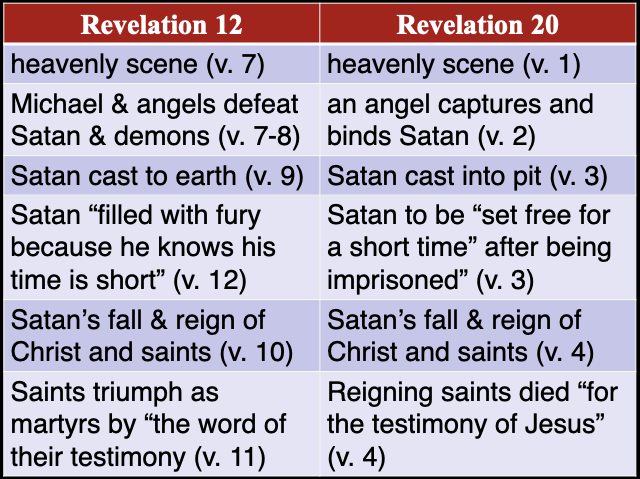
Let's compare a passage we looked at recently—Revelation 12—with Revelation 20.
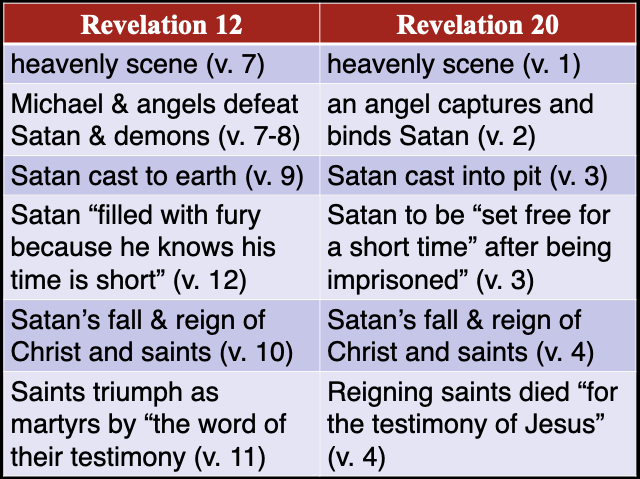
One has a heavenly scene; the other has a heavenly scene. In Revelation 12, after the child is taken up to God and Satan is unable to destroy the child, there’s war in heaven, and Michael and his angels defeat Satan and the demons. In Revelation 20, what happens? An angel captures and binds Satan. In Revelation 12, Satan is cast down to earth. In Revelation 20, Satan is cast down into the pit. In Revelation 12, he’s filled with fury because he knows his time is short. In Revelation 20, he is set free for a short time after being imprisoned. In Revelation 12, he falls, and then Christ and his saints are reigning. In Revelation 20, Satan falls, and Christ and his saints are reigning. In Revelation 12, the saints triumph as martyrs by the word of their testimony. In Revelation 20, the reigning saints died for the testimony of Jesus.
Now, all you math majors know that 12 comes before 19, but that doesn't mean everything pictured in Revelation 12 happens before everything pictured in Revelation 20. Revelation 12 and 20 are largely describing the same things, using different pictures. So don’t base your chronology of events on which chapter comes after a previous chapter of Revelation.
Here's another example. The last two chapters cover the very end of the age and eternal life—there’s no doubt about that. But there are also visions of the end of the world and eternal life in earlier chapters. These visions overlap and they’re not always in time sequence.
Souls refuse beast and reign now
Having said all that, what does it mean that millions have already refused the beast and the first resurrection has already happened for souls who are with Christ in heaven? This is important for us to know, and it was super important for those first believers. What happens to Christians who are getting killed? When you get eaten by lions, when you get your head chopped off, when you get crucified, when they pour tar over you and light you on fire—is that the end? What happens to all those dead people who have been slaughtered by the Roman beast?
4 I saw the souls of those who had been beheaded for the testimony of Jesus and for the word of God, and those who had not worshiped the beast or its image and had not received its mark on their foreheads or their hands. They came to life and reigned with Christ for a thousand years. 5 The rest of the dead did not come to life until the thousand years were ended. This is the first resurrection. 6 Blessed and holy is the one who shares in the first resurrection! Over such the second death has no power, but they will be priests of God and of Christ, and they will reign with him for a thousand years. (Revelation 20:4–6).
What happens to Christians when they die? Some think there’s soul sleep. The answer is, they go to be with Christ. And not only are they with Christ, but the souls of those who’ve been martyred and killed are in heaven. They’re present. They’re crying, “How long is it going to go on?” while others are being killed and persecuted in various parts of the world. Those prayers are heard by God. And in the meantime, while those prayers are going up, they are not only communicating with Christ, they are reigning with Christ.
The Bible doesn’t give us a lot of detail about what’s called the intermediate state—what happens between when you die and when your body is resurrected and we’re in the perfect new creation. What it does reveal is that to be present with Christ is far better than life in our present body (Philippians 1:23), that we communicate, we’re conscious in that state, and that we even have a participation in Jesus’ reign over all things from heaven. That’s what happens to souls who are with Christ.
You might say, “But Revelation 20:4 speaks of those who were beheaded. It’s not talking about all believers.” Again, beware of overly literalistic interpretation of the pictures of Revelation. When it speaks of those beheaded for the sake of Christ, it doesn’t just mean those whose heads were chopped off. Those who were eaten by lions would also qualify. The crucified would qualify. Those who were burned as torches—all the martyrs, not just the beheaded ones, are meant there.
Indeed, Revelation is speaking not just of the martyrs who literally died at the hands of persecutors, but all those who gave their lives for Christ. There are different forms of martyrdom. One form is to give your life for Christ in dying; another is to give your life for Christ in living for him—in giving your whole life in his service. That’s what it means to be a Christian.
All who belong to Christ and who die in their bodies go as souls to be with him forever. Those souls experience the first resurrection. The first resurrection is this: you are with Jesus Christ, and you are already in the full experience of a soul communing with Jesus Christ without any more veil, any more limitations on your knowledge of him. You are in his presence and you are sharing in his power over the universe. You have experienced the first resurrection when you go to be with him after you die. And when you’ve experienced that first resurrection, you are guaranteed that your body is going to be glorified and reunited with your glorified soul. That is absolutely certain to happen.
There is no possibility that the second death—which is hell—can ever touch you, because you’ve already experienced the first resurrection. You are a soul made eternally his, in his presence, so the second death has no power of you. We will be priests of God and of Christ and reign with him for that whole "thousand-year" period—and not only that, but as we’ll see in Revelation 21 and 22, forever and ever in our new, glorified bodies.
Millennium is now
- Millennium = “last days,” the period between Jesus 1st and 2nd comings.
- Jesus’ kingdom reign has already begun.
- Satan is already bound and cast down.
- Millions have already refused the beast.
- “First resurrection” has already happened for souls who reign with Christ in heaven.
When we think about the millennium, I don’t want it to be just an intellectual puzzle, where you say, “I wonder who’s right—the postmills, the premills, the amills, the dispensationalists. Let’s see, I’ve read several novels and fourteen theology books on it, and I’m still scratching my head. Now what?” Reach the best understanding you can based on the study that you do. But above all, remember that Jesus reigns, and that you are to respond to that reign by loving him, trusting him, submitting to him, and obeying him.
Remember that Satan is limited. Don’t think you’ve got a good excuse when you say, “The devil made me do it.” He didn’t. You let him make you do it. And when you know a believer who goes to be with the Lord, don’t say, “We really don’t know what happens after somebody dies.” Yes, we do. The soul goes to be with Christ, enters into his glorious reign, experiences tremendous blessing from him, and is headed for that day when the perfect soul is united with the perfect body and reigns forever and ever.
Take comfort in that. A lot of us in this church in recent months have lost people—saints of God whom we love very much. They are reigning with Christ. And meanwhile, here on earth, we participate in his activities here, and we look forward to the day when we’re with him— either when we die, or if he hastens the day when he comes back and makes all things new and we meet him face to face even before our souls leave our bodies.
Seek the Lord while he may be found. Call on him while he’s near (Isaiah 55:6). Satan loses. Don’t side with him just because it might seem more convenient for a little while. Jesus wins. Don’t side against him or turn from him just because his cause seems to take a hit here or there. We already know who wins the war. Now we just need to be faithful in our area of the battle.
Prayer
Father, help us by your Spirit and your truth to grasp in the depths of our souls what you’re saying to us in the marvelous truths of Revelation and the rest of your Scriptures. Help us, Lord, to live in the victory of Jesus Christ, to live with a deep awareness of Satan and the deceptions and attacks of his demons, and at the same time to know the limits you’ve placed on those activities and the power that we have through the Holy Spirit in us. Give each of us, Lord, courage as soldiers in your battle, and prepare us for the day when we join those other saints who are already reigning with you in glory. We pray in Jesus’ name. Amen.
Millennium
By David Feddes
Slide Contents
1 And I saw an angel coming down out of heaven, having the key to the Abyss and holding in his hand a great chain. 2 He seized the dragon, that ancient serpent, who is the devil, or Satan, and bound him for a thousand years. 3 He threw him into the Abyss, and locked and sealed it over him, to keep him from deceiving the nations anymore until the thousand years were ended. After that, he must be set free for a short time.
4 I saw thrones on which were seated those who had been given authority to judge. And I saw the souls of those who had been beheaded because of their testimony about Jesus and because of the word of God. They had not worshiped the beast or its image and had not received its mark on their foreheads or their hands. They came to life and reigned with Christ a thousand years. 5 (The rest of the dead did not come to life until the thousand years were ended.) This is the first resur-rection. 6 Blessed and holy are those who share in the first resurrection. The second death has no power over them, but they will be priests of God and of Christ and will reign with him for a thousand years. (Revelation 20:1-6)
Millennium is now
- Millennium = “last days,” the period between Jesus 1st and 2nd comings.
- Jesus’ kingdom reign has already begun.
- Satan is already bound and cast down.
- Millions have already refused the beast.
- “First resurrection” has already happened for souls who reign with Christ in heaven.
Jesus reigns now
The time has come. The kingdom of God has come near. (Mark 1:15)
If I drive out demons by the finger of God, then the kingdom of God has come upon you. (Luke 11:20)
The kingdom of God is in your midst. (Luke 17:21)
All authority in heaven and on earth has been given to me. (Matthew 28:18)
Ruler of the kings of the earth… I hold the keys (Revelation 1:5, 18)
The lamb at the center of the throne… opened the seals (Revelation 5:6; 6:1)
Satan bound now
But if it is by the Spirit of God that I cast out demons, then the kingdom of God has come upon you. Or how can someone enter a strong man's house and plunder his goods, unless he first binds the strong man? (Matt 12:28-29)
God did not spare angels when they sinned, but sent them to hell, putting them in chains of darkness to be held for judgment. (2 Peter 2:4)
These he has kept in darkness, bound with everlasting chains for judgment on the great Day. (Jude 1:6)
1 And I saw an angel coming down out of heaven, having the key to the Abyss and holding in his hand a great chain. 2 He seized the dragon, that ancient serpent, who is the devil, or Satan, and bound him for a thousand years.
Satan cast out now
Now is the judgment of this world; now will the ruler of this world be cast out. And I, when I am lifted up from the earth, will draw all people to myself. (John 12:31-32)
- “cast out” is the same Greek root as “casting” Satan into the pit in Rev. 20:3
Satan locked up
3 He threw him into the Abyss, and locked and sealed it over him, to keep him from deceiving the nations anymore until the thousand years were ended. After that, he must be set free for a short time.
- Can’t cause God’s chosen to perish
- Can’t cause global assault on the church
Millennium is now
- Millennium = “last days,” the period between Jesus 1st and 2nd comings.
- Jesus’ kingdom reign has already begun.
- Satan is already bound and cast down.
- Millions have already refused the beast.
- “First resurrection” has already happened for souls who reign with Christ in heaven.
Millennial views
- Premillennial: Jesus returns before; millennium lasts exactly 1,000 years
- Postmillennial: Jesus returns after; millennium is a figurative period of time
- Amillennial: Jesus returns after; millennium is now, between comings
Interpreting
- Scripture interprets Scripture
- Clear before difficult
- Literal before figurative
- Big picture before details
Big picture
- Jesus wins
- Satan loses
Interpreting
- Different forms, same truths
- Pictures symbolize realities
- First coming launched last days
- Visions overlap, same story
- Partial fulfillments, then final
Millennium is now
- Millennium = “last days,” the period between Jesus 1st and 2nd comings.
- Jesus’ kingdom reign has already begun.
- Satan is already bound and cast down.
- Millions have already refused the beast.
- “First resurrection” has already happened for souls who reign with Christ in heaven.
Souls reign now
4 I saw the souls of those who had been beheaded for the testimony of Jesus and for the word of God, and those who had not worshiped the beast or its image and had not received its mark on their foreheads or their hands. They came to life and reigned with Christ for a thousand years. 5 The rest of the dead did not come to life until the thousand years were ended. This is the first resurrection. 6 Blessed and holy is the one who shares in the first resurrection! Over such the second death has no power, but they will be priests of God and of Christ, and they will reign with him for a thousand years.
Millennium is now
- Millennium = “last days,” the period between Jesus 1st and 2nd comings.
- Jesus’ kingdom reign has already begun.
- Satan is already bound and cast down.
- Millions have already refused the beast.
- “First resurrection” has already happened for souls who reign with Christ in heaven.