
Transcript & Slides: Paradise
Paradise
By David Feddes
We’re going to finish our series of six messages on Revelation by looking at what it says about paradise, especially in the final two chapters, although it does picture paradise often throughout the book. Today we’re going to look at what it says in Revelation chapters 21 and 22.
21:1 Then I saw a new heaven and a new earth, for the first heaven and the first earth had passed away, and there was no longer any sea.2 I saw the Holy City, the new Jerusalem, coming down out of heaven from God, prepared as a bride beautifully dressed for her husband. 3 And I heard a loud voice from the throne saying, “Now the dwelling of God is with men, and he will live with them. They will be his people, and God himself will be with them and be their God. 4 He will wipe every tear from their eyes. There will be no more death or mourning or crying or pain, for the old order of things has passed away.”
5 He who was seated on the throne said, “I am making everything new!” Then he said, “Write this down, for these words are trustworthy and true.”
6 He said to me: “It is done. I am the Alpha and the Omega, the Beginning and the End. To him who is thirsty I will give to drink without cost from the spring of the water of life. 7 He who overcomes will inherit all this, and I will be his God and he will be my son. 8 But the cowardly, the unbelieving, the vile, the murderers, the sexually immoral, those who practice magic arts, the idolaters and all liars—their place will be in the fiery lake of burning sulfur. This is the second death.”
9 One of the seven angels who had the seven bowls full of the seven last plagues came and said to me, “Come, I will show you the bride, the wife of the Lamb.” 10 And he carried me away in the Spirit to a mountain great and high, and showed me the Holy City, Jerusalem, coming down out of heaven from God. 11 It shone with the glory of God, and its brilliance was like that of a very precious jewel, like a jasper, clear as crystal.12 It had a great, high wall with twelve gates, and with twelve angels at the gates. On the gates were written the names of the twelve tribes of Israel.13 There were three gates on the east, three on the north, three on the south and three on the west.14 The wall of the city had twelve foundations, and on them were the names of the twelve apostles of the Lamb.
15 The angel who talked with me had a measuring rod of gold to measure the city, its gates and its walls.16 The city was laid out like a square, as long as it was wide. He measured the city with the rod and found it to be 12,000 stadia in length, and as wide and high as it is long. 17 He measured its wall and it was 144 cubits thick, by man’s measurement, which the angel was using.18 The wall was made of jasper, and the city of pure gold, as pure as glass. 19 The foundations of the city walls were decorated with every kind of precious stone. The first foundation was jasper, the second sapphire, the third chalcedony, the fourth emerald, 20 the fifth sardonyx, the sixth carnelian, the seventh chrysolite, the eighth beryl, the ninth topaz, the tenth chrysoprase, the eleventh jacinth, and the twelfth amethyst. 21 The twelve gates were twelve pearls, each gate made of a single pearl. The great street of the city was of pure gold, like transparent glass.
22 I did not see a temple in the city, because the Lord God Almighty and the Lamb are its temple. 23 The city does not need the sun or the moon to shine on it, for the glory of God gives it light, and the Lamb is its lamp.24 The nations will walk by its light, and the kings of the earth will bring their splendor into it.25 On no day will its gates ever be shut, for there will be no night there. 26 The glory and honor of the nations will be brought into it. 27 Nothing impure will ever enter it, nor will anyone who does what is shameful or deceitful, but only those whose names are written in the Lamb’s book of life.
22:1 Then the angel showed me the river of the water of life, as clear as crystal, flowing from the throne of God and of the Lamb 2 down the middle of the great street of the city. On each side of the river stood the tree of life, bearing twelve crops of fruit, yielding its fruit every month. And the leaves of the tree are for the healing of the nations. 3 No longer will there be any curse. The throne of God and of the Lamb will be in the city, and his servants will serve him. 4 They will see his face, and his name will be on their foreheads. 5 There will be no more night. They will not need the light of a lamp or the light of the sun, for the Lord God will give them light. And they will reign for ever and ever.
All things new
“Behold, I am making all things new” (Revelation 21:5). "I saw new heavens and a new earth" (Revelation 21:1). The Bible speaks again and again of the re-creation, renewal, and restoration of God’s universe. Jesus himself speaks of "the rebirth [or the regeneration] when the Son of Man sits on his glorious throne," the whole universe reborn (Matthew 19:28). The apostle Peter preached, “He must remain in heaven until the time of the restoration of all things” (Acts 3:21). The apostle Paul writes, "The creation will be freed from its bondage to decay into the freedom of the glory of the children of God” (Romans 8:21).
This tremendous rebirth and restoration of all things, a creation of a new heaven and a new earth, was already foretold hundreds of years before Jesus came. The prophet Isaiah said, “Behold, I will create new heavens and a new earth. The former things will not be remembered, nor will they come to mind. But be glad and rejoice in what I will create, for I will rejoice over Jerusalem and take delight in my people. The sound of weeping and of crying will be heard in it no more” (Isaiah 65:17-19).
This new creation is an earthly creation. It involves a new heaven but also a new earth. Revelation emphasizes that this is not just an existence somewhere in the clouds or in an indefinite fog bank. “You have made them to be a kingdom and priests to our God, and they shall reign on the earth” (Revelation 5:10). Jesus says, “Blessed are the meek, for they shall inherit the earth” (Matthew 5:5). And the prayer he taught us is, “Our Father who art in heaven, hallowed be thy name. Thy kingdom come, thy will be done on earth as it is in heaven” (Matthew 6:9-10).
In a sense, Revelation is simply an explanation of the process by which that prayer is answered. When you read the book of Revelation, you find in the early chapters, after the message to each of the seven churches, a vision of heaven, and God’s will is done in heaven. Everybody in heaven is praising the Father and praising the Lamb, and the angels and the saints and all in heaven are praising, and it is perfectly ordered according to God’s will. Then at the end of Revelation you see heaven coming to earth, and earth is glorious and beautiful, and all are praising God, and everything is ordered according to God’s will. We pray for God’s will to be done perfectly on earth as it’s already done perfectly in heaven, and the new creation is the answer to that prayer. Then the earth will be everything God meant it to be, everything he originally designed it to be when he made the original paradise. He’s going to turn the earth into the fully matured and perfect paradise.
Physical paradise
- Our final home is on a physical earth. Heaven comes down to earth.
- God’s original creation will not just be destroyed. This world (like our bodies) will perish but then rise in glory.
- Eternal pleasures on the new earth come from the Creator of this earth.
It’s going to be an earthly paradise, and that means among other things that it’s physical or bodily. Our final home is on a physical earth that we can touch and see, an earth very much like our own, only new and improved and purified. Heaven comes down to earth.
When people die, their souls live in heaven in an existence that’s hard for us to imagine, but we know they go to be with Christ to enjoy conscious communion with Christ and to reign with Christ, as Revelation portrays it. But we also know that that’s not our final destiny. Our final destiny is not heaven in heaven. Our final destiny is heaven on earth. We’re earthly creatures, we’re bodily, and we’re meant to have bodies for eternity. When Jesus comes again, those souls that have been in heaven will receive new resurrection bodies, and those who are still living on earth will have their bodies instantly transformed, and God will bring about his new heaven and new earth.
God’s original creation is not just a sinking ship. There is a great transformation where the old order of things passes away, and yet this world, though it will perish, is going to be raised again, just like our bodies which perish and then we receive a new body. It’s not just a totally new body, totally different. We’re still us. It’s our body, recognizable, only transformed and made better. That’s true of the whole earth, the whole creation. It will perish at the end of this age but then rise again in freshness and newness and perfection and glory.
This also means that the eternal pleasures on the new earth are going to be coming from the Creator of this earth. Some of us might say, "I’d rather go to heaven than hell, but what I'd really prefer is to stay here living on earth.." If life is going well, people aren’t always eager for the new heavens and the new earth. We need to realize that the one who invented this earth and made all the things we enjoy most on this earth is also the creator of the new earth.
In the renewed earth, the pleasures won’t be mixed with miseries, and the things that spoil the creation now are going to be removed. The creation will be what it’s meant to be in perfection, and the things that we delight in now will still be there or have something that’s even better that surpasses the delights that we know now. So when we think of that coming new heaven and new earth, we need to realize that it’s earthly, that it’s physical, that it’s bodily. You should not get lost in that notion about your eternal state as an eternal fog bank with a bit of light in it. It is being restored to be who you were meant to be, and the creation restored to what it’s meant to be.
Not in paradise
Now, when we think about paradise, one of the great things to know about paradise is what’s not there. We’ll talk about what is in paradise, but first what’s not.
Satan is not in paradise. His demons are not in paradise. You and I do not know what it’s like to live in a world without demonic influences at work, wrecking things, whispering lies in our ear, trying to divide people against each other, trying to poison our relationship with God. We don’t notice most of the time directly what Satan and his demons are up to, but we’ve never lived in a world where they have not been active. We will find out what it’s like when all of those demonic influences are gone.
There will be no more evil in the world. “Nothing impure will ever enter it, nor will anyone who does what is shameful or deceitful” (Revelation 21:27). That means that every person who is there is going to be somebody who has been perfected. Everything wrong with you, everything sinful about you, will be cleansed and taken away. You won’t be a bother and an offense to anybody else, nor they to you, because we’ll each be made perfect there. Those who refuse Jesus, who don’t want Jesus, who don’t want to be with Jesus, simply won’t be there.
There will be no more death or mourning or crying or pain, says Revelation (Revelation 21:4). No hospitals, no cemeteries, no funerals, no places of mourning and sorrow, no counseling clinics for those who are struggling in their life with past traumas, no medications for those with mental illnesses, none of the griefs that linger with us throughout life over the people we’ve lost or the things that we’ve endured. No more death, no more mourning, no more crying, no more pain or suffering.
There will be no more curse. Remember where all the pain and problems came from. At the very beginning there was a paradise. It wasn’t completely what it was going to be yet, but there was a garden and there was a beautiful creation. If Adam and Eve had tended it well and expanded that garden throughout the rest of creation, it could have been an even greater paradise. But they sinned, they listened to the serpent, and a curse came upon the creation. Again, we don’t know what it’s like to live in a creation with no curse. We live in a sin-cursed world, where our work is often frustrated, where children die in infancy, where tragedy strikes, where moms give birth and even that moment of great joy is one of terrible pain, where children bring great joy but also great heartache. These are all results of that original curse that hit the creation and shattered what it was meant to be. Well, in paradise, no more curse. The relationships all healed, the universe all working the way it was meant to work. You’ve had days, haven’t you, where stuff just breaks down, things go wrong? That’s all part of a messed-up world, but the renewed world won’t be messed up anymore.
Besides the removal of the curse and its consequences, Revelation speaks of other things that won't be in the new creation when heaven comes to earth. It says, "There was no longer any sea" (Revelation 21:1). Some of you might say, "But I like the sea! I like boating. I like being on the beach. It would be kind of a rip-off to get to the new creation and not have any lakes or oceans."
I don’t think Revelations is saying there will be no lakes or oceans. When it says there will be no more sea, it says this in the context of the old order of things passing away. In the book of Revelation, what comes out of the sea? The beast comes out of the sea, the one who is sometimes labeled the godless one or the antichrist or Gog. The beast comes out of the sea. When the prostitute, wicked Babylon, is pictured, where does she sit? She sits on the sea, which represents many wicked nations in rebellion against God. In Revelation "the sea" often represents the chaos that evil comes out of. In heaven on earth, there won’t be any chaos from which evil emerges anymore. So we shouldn’t read “no more sea” to mean no more Lake Michigan, no more Pacific or Atlantic Ocean. The point is not that there will be no more large bodies of water but that there will be no more chaos from which the monsters and the evil come against us.
There will be no more night (Revelation 21:25). This might mean that there’s perpetual brightness and shining, or maybe God will let there be night in the sense that there will be enough darkness to see some stars and enjoy them. However that may be, the sense that there is no more night means that God will continue to give us his brightness and his glory. There won’t be a need for lights. The city won’t need the sun to shine on it, won’t need the moon, won’t need a lamp, because the Lord God and the Lamb are its light (Revelation 21:23).
Maybe you remember the days of creation in Genesis 1. Light came on the first day; the bodies that give light didn’t show up till the fourth day. Some people say, "That can’t be! That’s just ridiculous, and it proves Genesis is a myth." Whatever you happen to think of that order of things in creating, the Bible ends pretty much the way it began by saying, "Yes, there’s going to be plenty of light, and you won’t need the sun or the moon to provide it." if God says, “Let there be light,” he himself is light, and he gives light.
There will be no temple in the city. We’ll say more later about paradise being one big temple, and yet there’s no temple in the city, because the Lord God Almighty and the Lamb are its temple (Revelation 21:22). In one sense, it's all a temple, but in another sense there is no temple there. You won’t need sacred buildings anymore, a tabernacle or a beautiful temple, or even churches or houses of worship. This probably also means there won’t be any preachers there. I trust that some of us preachers will make it to heaven on earth, but we won’t be preaching anymore because everybody will know the Lord from the least of them to the greatest (Jeremiah 31:34).
My fumbling sermons that try to say a little bit of this or that about God—in hindsight I’ll be embarrassed about my sermons. In paradise you might say of my sermons, "His preaching sure didn’t reveal very much about the Lord." But despite my sermons falling far short of the reality of God and heaven, preaching is a means of grace that God gives us here on earth. We need times to gather, times to worship, and places set apart by people called to proclaim the good news. But in paradise, you don’t need temples or churches or anything else, because God is there in all his beauty and glory, and all those other means are set aside as the reality is fully before us.
There won’t be marriage in paradise, except that we’re going to see that we are Christ's bride. Jesus himself said in that new creation there won’t be marriage or giving in marriage. We’re going to be like the angels in that sense. Marriage is a type of relationship that is beautiful and wonderful and meant to reveal things about God. It’s something not that’s merely going to be trashed, but something that we grow beyond, where we may still appreciate and love and know and recognize the spouse whom we had on earth. But that relationship is going to be swallowed up into something even greater that we can’t imagine yet (Matthew 22:30).
I don’t think there will be any zoos in that new creation either—and not because there won’t be any animals. You will not need to separate animals from each other anymore, and you won’t need to separate animals from people or have things to prevent them from running away from you, because the new creation is a place perfect harmony among animals and among people and the animals (Isaiah 11:6-9).
Those are some of the things that aren’t going to be in paradise. Thank God for what’s not in paradise!
Paradise
- Garden
- Temple
- City
- Family
What is there in paradise? Let’s think about four things from this great passage of Scripture that we can learn about paradise. It’s a garden, a city, a temple, and a family. You might object, "I thought you just said there wasn’t a temple or marriage." But temple and family both are lifted to a higher level.
Garden
- Tree of life: healing, life, pleasure
- River of life: pure, ever-deepening
- High mountain: grandeur, awe
- Working, relaxing, playing
- Animal harmony under human rule
- All creation singing and dancing
- Walking and talking with God
First of all, paradise is a garden. When the vision comes to John, he sees the tree of life, and the tree of life brings healing; it brings eternal life. It’s delicious and pleasurable. It’s a sign that God pours out all of his life and his pleasures and his gladness on us. That tree of life, which we were banned from after the sin in the garden of Eden, we have access to again.
The river of life is in paradise, as there was a river in the original paradise. Genesis says a river flowed from Eden. In the final, eternal paradise, the river of the water life is flowing, and on each side of the river, the tree of life is growing. Early in Revelation, the very first promise that Jesus gives to a church is this: “To him who overcomes, I will give to eat from the tree of life, which is in the paradise of God” (Revelation 2:7). In the very last chapter near the very end, Revelation says, “Blessed are those who wash their robes, that they may have the right to the tree of life and may go through the gates into the city” (Revelation 22:14).
In Genesis 3 Adam and Eve were kicked out of paradise, with no more access to the tree of life. God posted a cherub, a mighty angel, with a flaming sword to prevent anybody in this age from ever entering paradise and eating again from the tree of life. But in the eternal paradise, heaven on earth, the angels are not banning people at the gates; they’re welcoming people in. The tree of life is there for the eating, and its leaves are for the healing of the nations (Revelation 22:2).
Revelation is building on a vision that God gave centuries earlier. Ezekiel 47 says, “On the banks, on both sides of the river, there will grow all kinds of trees for food. Their leaves will not wither, nor will their fruit fail, but they will bear fresh fruit every month because the water for them flows from the sanctuary. Their fruit will be for food and their leaves for healing” (Ezekiel 47:12). That’s the river of life and the tree of life.
In Ezekiel’s vision, the depth of this river is measured at various points. At first, when it comes out of the sanctuary, it’s very shallow. But the farther you go along that river, somehow it keeps getting deeper and deeper. First it’s up to your knees, then it’s up to your waist, and finally it’s a mighty river that you can’t stand in, that you can only swim and splash around in.
That’s the mighty river of life that God has in mind. Whatever that means—whether literal rivers and literal trees that bring us life and healing—we know that often in the Bible the water of life, the spring of life, is God the Holy Spirit, whom God pours out upon us. If he does that by means of a river and a tree that we eat of, or whether the Holy Spirit does that directly, this picture of the tree of life bringing healing, pleasure, and gladness, and the river of life flowing ever deeper shows a restoration of the garden of Eden, only better.
Another aspect of a garden is a great, high mountain. This is connected with things God promised long before. “On this mountain the Lord Almighty will prepare a feast of rich food for all peoples, a banquet of aged wine—the best of meats and the finest of wines. On this mountain he will destroy the sheet that covers all nations, the shroud that covers all peoples; the Sovereign Lord will wipe away the tears from all faces; he will remove the disgrace of his people from all the earth. The Lord has spoken” (Isaiah 25:6-8). That’s what God is going to do on this mountain.
Paradise features this great and mighty mountain, the river of life, and the tree of life. Every time you look at a wondrous mountain even now, think of that future mountain in paradise. Every time you see a river or a beautiful stream, think of that river of the water of life that’s going to flow forever. Every time you look at a beautiful tree or eat some delicious fruit, remember there’s better fruit coming from the tree of life. Earthly mountains, rivers and fruit trees are faint memories of what once was in Eden and appetizers for what’s coming in paradise.
In the original garden of Eden, what were Adam and Eve called to do? They were called to tend it, to take care of it, to make it better and better, to develop it. You might wonder, "What in the world are we going to do in paradise? Do we just get to sleep in every morning and then get up and do nothing?" You won’t need to sleep because you won’t get tired. In addition, work is going to be enjoyable, not drudgery. Work in paradise means succeeding at everything you do and using all the gifts and abilities God gave you to bring out the best in the creation around you and to develop it in wonderful ways.
Science, discovery and invention will not be poisoned by other agendas and by our own weaknesses and ignorances. Woodworking and building and planting will produce great results for us to enjoy. “They will build houses and dwell in them; they will plant vineyards and eat their fruit” (Isaiah 65:21). The work that we do in developing that beautiful creation is going to be fun and productive.
But it won't be all work. We can also play and relax. The Bible speaks of children playing in the streets of the city (Zechariah 8:5). People can rest and relax whenever they wish.
In the perfect garden, on God's holy mountain, there will be perfect harmony among animals and people. “The wolf will live with the lamb, the leopard will lie down with the goat, the calf and the lion and the yearling together, and a little child will lead them. The cow will feed with the bear, their young will lie down together, and the lion will eat straw like the ox. The infant will play near the hole of the cobra, and the young child will put his hand into the viper’s nest. They will neither harm nor destroy on all my holy mountain, for the earth will be full of the knowledge of the Lord as the waters cover the sea” (Isaiah 11:6-9).
There will be perfect harmony of the animals among each other and of humanity with the animals. We were appointed to govern the animal kingdom. When humanity fell into sin, it messed things up for the animals too. That’s the short version. When we’re restored to our proper position and our proper way of handling our position in governing creation, then everything will be set right with the animal kingdom too.
You can start guessing about what else that might mean—whether animals will be able to communicate with us in ways they can’t now. I’ve got a brother who trains dogs. Those dogs already know quite a bit of what he’s talking about. Who knows what will happen when we get into a creation where our stupidities and the curse are removed, and the animals and the people are in perfect harmony.
The Bible even goes further than that and pictures all creation singing and dancing: “Let the heavens be glad, let the earth rejoice; let the sea roar and all that fills it; let the field exult and everything in it. Then all the trees of the forest will sing for joy before the Lord” (Psalm 96:11-12).
There are many prophecies and songs about creation dancing and rejoicing. What’s God going to do with the plant kingdom and the mountains? What does it mean when they’re praising the Lord and rejoicing? You might say, "That’s just poetry." But sometimes there are things so amazing that only poetry, not prose, can express them at this point in time. "The creation itself will be set free from its bondage to decay and brought into the glorious freedom of the children of God" (Romans 8:21).
Another great thing—indeed, the best thing—about the garden of Eden was that God himself would come into that garden, and he would walk with Adam and Eve and talk with them. After they sinned, they were afraid of god, and they couldn’t be in the garden, and they never had that same relationship again. But it will be restored.
A lot of older people love a song called “In the Garden.” Others dislike that song because they think it’s bad poetry or lame music or whatever, but I understand its appeal. “I come to the garden alone… and he walks with me and he talks with me, and he tells me I am his own.” This is the deepest longing of the human heart: to be in the paradise of God and to be walking with him and talking with him, not just at a distance in prayer, but so directly that we know he’s right there with us at all times, and we hear him speak and he listens to us speak. Walking and talking with God is the supreme delight of the garden.
Temple
- God’s permanent dwelling on earth
- Enormous, cubic Holy of Holies
- Shekinah shining, see his face
- All priests, Name on foreheads
- We are God’s temple, adoring Him
- God and Christ are our temple
That was the whole point of Israel's tabernacle and temple all along—the place where God showed up on earth and the place where you could go to meet God. There were various levels of access. If you were an ordinary person, you could get into the outer court but no closer. If you were a priest, you could get into the inner court. If you were the high priest, you could get into the holy of holies once a year. That’s how the temple worked. It was largely forbidden territory in its innermost part.
What is the holy city in the vision of paradise? It's an enormous cube. That the very same shape as the holy of holies in the ancient tabernacle and temple: a cube. But in paradise the holy of holies is not a little cube that only one person gets to enter once a year. It is a vast and gigantic space where all are welcome all the time.
We read with longing of the tabernacle being filled with the Shekinah, the shining, the glory of the Lord. That brightness would fill the holy of holies. It was the shining of God's face. Revelation says, “We shall see his face” (Revelation 22:4). In the Bible people would pray, “Lord, let your face shine upon us, that we may be saved” (Psalm 80:3). The blessing of the priest is, “May the Lord make his face to shine on you and be gracious unto you” (Numbers 6:25).
The great longing of those who love God is expressed in Psalm 27: “One thing I ask of the Lord, this is what I seek: that I may dwell in the house of the Lord all the days of my life, to gaze upon the beauty of the Lord and to seek him in his temple” (Psalm 27:4). My heart says, “Seek his face!” Your face, Lord, I will seek (Psalm 27:8). That is the heart’s cry of believers expressed in Psalm 27, and Revelation says that our heart’s desire is going to come true. “We shall see his face” (Revelation 22:4)—the face of the one who loved us and bled for our salvation, the face whose shining is beauty, the face that brings all good things in life.
Not only does Revelation speak of this huge holy of holies where we see God's face, but it says that we are all priests of God there. Revelation says repeatedly that God makes his people priests. Here in the final chapter of Revelation it speaks of his name being on our foreheads (Revelation 22:4). Now, who has God’s name on their forehead in the Old Testament? The high priest. “You shall make a plate of pure gold and engrave on it ‘Holy to the Lord.’ You shall fasten it on the turban by a cord of blue on the front of the turban on Aaron’s forehead” (Exodus 28:36–37). The high priest of God is the one with “Holy to the Lord” on his forehead. So when it says, “They shall see his face and his name will be on their foreheads,” it means that you are like Aaron, the high priest of God, who gets to go into the holy of holies—only you get to be there perpetually and never leave.
When you think about a temple, you might think of grand architecture, but it doesn’t really make your heart go pitter-patter. But what about the thought of seeing his face, of being always in his presence and in that great and glorious holy of holies? Does that make your heart go pitter-patter?
The New Jerusalem in paradise is pictured as a place where everything is paved with gold or covered with gold, beautiful transparent, shining gold. In the Old Testament, the tabernacle, the holy of holies, the temple—everything was gold. These are all ways of saying that the things the tabernacle pointed to, that the temple pointed to, are fulfilled in paradise.
The Bible says over and over that we’re God’s temple. Your body even now is the temple of the Holy Spirit (1 Corinthians 6:19). The church is God’s temple; God’s people together are his temple (Ephesians 2:21). But here Revelation goes beyond saying we’re his temple; it says God is our temple. God and Christ are our temple. We don’t need a temple building anymore simply because we’re dwelling in God. The apostle Paul writes of the new creation: “God will put all things under his feet. The last enemy to be destroyed is death. Then Christ hands the kingdom over to the Father, and God will be all in all” (1 Corinthians 15:27-28). That’s what’s meant by God being our temple. He’s our everything, our all in all. God is our place of worship—none of the helps, none of the symbols anymore, but God himself.
City
- Throne: God and Lamb reign
- Gates: pearl, open, angels, 12 tribes
- Foundations: 12 apostles’ names
- Unity: 12,000 stadia cubed; all nations
- Safety: wall of 144 (12x12) cubits
- Beauty: gold, jewels, radiance
- Authority: ruling earth and angels
Paradise is a city. It comes out of heaven from God, but does come down to earth. Remember, this is ultimately an earthly city as well as a heavenly city. It’s heaven on earth
The city is run by somebody. It’s organized, and somebody’s on the throne. God and the Lamb reign in that city (Revelation 22:3).
The city has gates. Scripture tells us that each gate is made of a giant pearl. Every gate is open, never shut. You always have full access to God in paradise because the gates are never shut. At each of those gates stands an angel, but now not with a flaming sword to keep people away from God, but to welcome people into the presence of God. Each gate has on it the name of one of the twelve tribes of Israel. When you get to the foundations, it has twelve great foundation stones. Each of those has the name of one of the twelve apostles. This shows us that God’s Israel and God’s church are all one in that great paradise of God.
The city is a city of twelves—it’s twelve everywhere. That’s why you have to be careful about the modern translations. Some of them don’t say twelve thousand stadia; instead, they say, “1,400 miles.” But giving the literal distance may miss the point. 12,000 is twelve times a thousand. Twelve is a great number of completeness; a thousand is a great number of completeness. Revelation is probably not just giving us literal measurements and math. The point is in the twelves in the thousands and in the completeness.
In this great, unified city, Israel and the church are together. It is twelve thousand stadia cubed—a place of great unity where all nations are part of that city.
The wall also involves twelves: twelve times twelve, 144 cubits. This means total safety and security.
The city is a place of dazzling beauty, adorned with gold, precious jewels, and the radiance of God. What will it be like to see the brightness of God himself shining on his greatest jewels?
Amazingly, the throne of the city is not just where God and the Lamb reign. It is also a throne that God shares with others. God loves to share and delegate authority. The final promise that Jesus makes to the seven churches is this: “To him who overcomes, I will give the right to sit with me on my throne, just as I sat down with my Father on his throne” (Revelation 3:21). God shares his throne with his beloved people. “They will be a kingdom and priests to serve our God, and they will reign on the earth” (Revelation 5:10).
This brings us back to our original position in Genesis 1. God appointed Adam and Eve to rule over the beasts of the earth and all the creatures that move along the ground and the animals (Genesis 1:26). Psalm 8 celebrates the fact that God placed all things under humanity's feet—"all flocks and herds, beasts of the field, birds of the air, fish of the sea, all that swim the paths of the sea. O Lord, our Lord, how majestic is your name in all the earth!” (Psalm 8:6-9). Even after our fall into sin, God still gives humans some authority over the earth, but this is just partial taste of what is coming. In paradise, when heaven comes to earth, our God-given authority will be fully released when we sit with Jesus on his throne and reign with him.
This authority means that our bodies will be able to do some things that are hard to imagine now. Jesus could walk on water, and I don’t think that’s just because he was divine. It was his human body walking on water, exercising his rightful authority over the elements. When Christ comes again, gravity isn’t going to hold us down. We’re going to rise up and fly up to meet him (1 Thessalonians 4:17). Our bodies are going to have capacities that go beyond anything we know now, in part because we’re going to have additional authority over how our bodies operate, but also over how the creation operates.
The Bible even suggests that we will judge and govern angels. Angels will be our helpers. That’s part of ruling with Christ. Remember, Jesus did not become an angel; he became human. In becoming human and being exalted again to the throne of God, he took humanity up with him and raised and promoted and exalted humanity above the level even of the mighty and wonderful angels of God (1 Corinthians 6:3; Hebrews 2:6-9).
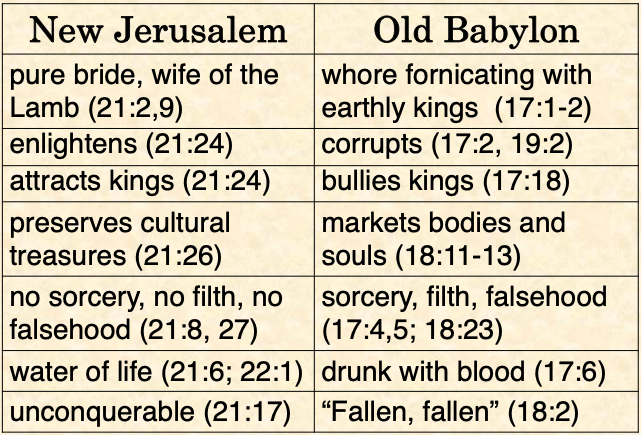
When we look at that city, it’s worth pointing out a sharp contrast between the two cities in Revelation—between the new Jerusalem and old Babylon.
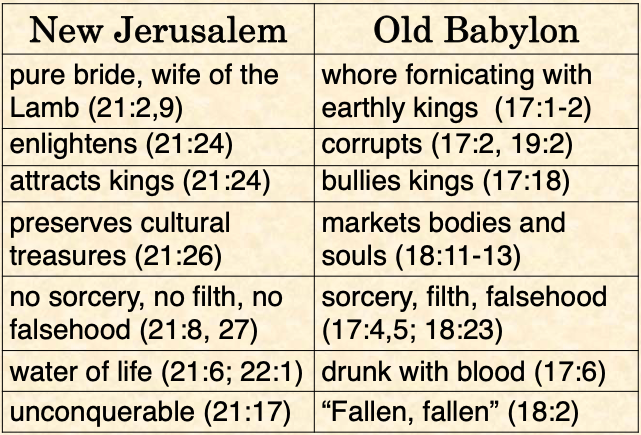
The new Jerusalem is a pure bride, the wife of the Lamb. Old Babylon is a woman fornicating with earthly kings. The new Jerusalem enlightens the nations. The old Babylon corrupts the nations. The new Jerusalem attracts the good things, the kings, and the cultural treasures of the earth. Old Babylon bullies the kings. The new Jerusalem preserves those cultural treasures as they’re brought into the city. Old Babylon—everything’s for sale, even bodies and souls. The new Jerusalem has no sorcery, no filth, no falsehood. Old Babylon is full of sorcery, filth, and falsehood. The new Jerusalem has the water of life. Old Babylon is drunk on blood. The new Jerusalem is unconquerable. Old Babylon is fallen. God's city stands forever.
Family
- Jesus’ bride, love and delight
- Father’s children and heirs
- Reunion, fellowship, knowing
- Feasting and eternal pleasures
- Delighting in our Lord
- Our Lord delighting in us
A final picture of paradise is the picture of family, of loving relationships.
We’re Jesus’ bride. We’re his love and his delight. Revelation speaks of that beautifully: “Let us rejoice and be glad and give him glory, for the wedding of the Lamb has come, and his bride has made herself ready. Blessed are those who are invited to the marriage supper of the Lamb” (Revelation 19:7, 9). When John sees the new Jerusalem, he says she’s “prepared as a bride beautifully dressed for her husband” (Revelation 21:2). When he’s about to get his tour of paradise, the angel says, “Come, I will show you the bride, the wife of the Lamb” (Revelation 21:9). Isaiah had spoken of this long before: “As a bridegroom rejoices over his bride, so shall your God rejoice over you” (Isaiah 62:5).
Marriage is just a little taste of the love that Jesus has for his people. The best marriage in this life is only a little taste of it; the worst marriage, of course, doesn’t give us much of a taste at all. One reason a broken marriage hurts so much is because something in us longs for so much in marriage, because we’re meant for a higher level of marriage. In paradise Jesus’ bride is with him, and the love and delight that we have in relating to him—that’s going to be our greatest joy for all eternity.
Revelation also pictures paradise as father and children relating to each other: “He who overcomes will inherit all this, and I will be his God and he will be my son” (Revelation 21:7). You’re a child of God, an heir of God. “If we’re children, then we’re heirs—heirs of God and co-heirs with Christ” (Romans 8:17). Everything that’s his is ours, even his throne. He’s willing to share even his throne! What else is there? If he shares his throne, there is absolutely nothing that he won’t share with us. The logic of the Bible says, “He who did not spare his own Son, but gave him up for us all—how will he not also, along with him, graciously give us all things?” (Romans 8:32). So if the Father gives us his Son and shares his throne, you don’t need to worry about your Father holding something back in the new creation that would bring joy and delight.
Christians look forward to different things about heaven, and well we should. One of the great joys is that it’s going to be a place of reunion. When a Christian loved one dies, you need not “grieve as those who have no hope” (1 Thessalonians 4:13). You’re going to see them again. They’re going to be raised again. They’re going to be glorified. So don’t grieve as though you had no hope. There’s going to be a wonderful reunion. We’re going to know our loved ones in heaven, we’re going to enjoy fellowship with them, we’re going to enjoy meeting a lot of different people that we didn’t know on this earth—the great heroes of the Bible. You can talk as long as you want with Abraham or Sarah, with Mary or John, or any of the great heroes of faith in the Scriptures, some from history who were heroic martyrs, people who helped bring the gospel in a previous generation, countless people whowere part of the chain of truth and gospel sharing that got the message to you.
You’re going to see angels and realize what your guardian angels did and how they were helpful to you throughout this life. So the reunion, the fellowship, the knowing, the feasting, the gladness, the pleasure—that’s all a huge part of paradise.
The Bible compares it to a wedding feast. Now when you think of a wedding feast, what are the things you look forward to? You look forward to the pageantry and the beauty of the wedding, as well as the fun that you’re going to have at the reception, and all the people you’re going to see—some of them are people you haven’t seen for quite a while. They’re coming from out of town, sometimes from a long way away, and you get to see them—and that’s all great. There are various things to look forward to about a wedding.
But if you’re the bride, you might look forward just a wee bit to the groom! Part of being Jesus' beloved, part of being his bride, is the banquet, the feast, the celebration, the eternal pleasures. But the greatest of all those pleasures will simply be delighting in the Lord.
When we think of heaven, we think of the reunion with dear ones, and the pleasures and the joys, and many other wonderful and exciting things. What will it be like to interact with the animals in a new way? Or to go to splendid waterfalls that we didn't get a chance to see in this life? Or maybe journey to a distant star or different system or galaxy? What a thrill that would be! All the joys of paradise that we look forward to are going to be wonderful—but the greatest joy is simply going to be seeing our Lord and delighting in him.
He’s the fountain of it all; the other things are only droplets. He’s the sun; all these other things are just rays. In paradise we’ll be seeing our Father and delighting in him, and that will be one of our supreme joys. But perhaps the greatest joy of all won’t be us delighting in him, but him delighting in us.
The Bible says, “As a bridegroom rejoices over his bride, so will your God rejoice over you” (Isaiah 62:5). “He will rejoice over you with singing” (Zephaniah 3:17). What will it be like to hear the voice that made the universe singing over you? What will it be like to hear him to say, “Come and share my joy” (Matthew 25:21)? That infinite, vast, unending, immeasurable joy—all his, all mine—where God is all in all.
This is what the Scriptures show. Like I said, I’m going to be embarrassed about this sermon when I get to paradise, not because I said too much, but because I said too little. I could only stammer a wee bit about things that I hardly know. When you get there—to the garden, the temple, the city, the great family of God—then you’ll know what I was trying to say. I hope you have a little hint now.
Prayer
Lord Jesus, kindle our hearts with a longing to see your face, a longing for
your kingdom to come on earth and your will to be done on earth as it is in
heaven, a longing for heaven itself to come down to earth and make this your dwelling
place forever in perfection. Lord, we look forward to paradise. May we be
among those who receive your promise: “The one who overcomes will have the
right to the tree of life in the paradise of God” (Revelation 2:7). We pray in
Jesus’ name. Amen.
Paradise
By David Feddes
Slide Contents
All things new
… the rebirth, when the Son of Man sits on his glorious throne… (Matt 19:28-29)
He must remain in heaven until the time of the restoration of all things. (Acts 3:21)
The creation itself will be freed from its bondage to decay into the freedom of the glory of the children of God. (Rom 8:21)
Earthly paradise
You have made them a kingdom and priests to our God, and they shall reign on the earth. (Revelation 5:9-10)
Blessed are the meek, for they shall inherit the earth. (Matthew 5:5)
Your kingdom come, your will be done, on earth as it is in heaven. (Matt 6:10)
Physical paradise
- Our final home is on a physical earth. Heaven comes down to earth.
- God’s original creation will not just be destroyed. This world (like our bodies) will perish but then rise in glory.
- Eternal pleasures on the new earth come from the Creator of this earth.
Not in paradise
- Satan
- Evil
- Death
- Crying
- Pain
- Curse
- Sea
- Night
- Lights
- Temple
- Marriage
- Zoo
Paradise
- Garden
- Temple
- City
- Family
Garden
- Tree of life: healing, life, pleasure
- River of life: pure, ever-deepening
- High mountain: grandeur, awe
- Working, relaxing, playing
- Animal harmony under human rule
- All creation singing and dancing
- Walking and talking with God
Temple
- God’s permanent dwelling on earth
- Enormous, cubic Holy of Holies
- Shekinah shining, see his face
- All priests, Name on foreheads
- We are God’s temple, adoring Him
- God and Christ are our temple
City
- Throne: God and Lamb reign
- Gates: pearl, open, angels, 12 tribes
- Foundations: 12 apostles’ names
- Unity: 12,000 stadia cubed; all nations
- Safety: wall of 144 (12x12) cubits
- Beauty: gold, jewels, radiance
- Authority: ruling earth and angels
Family
- Jesus’ bride, love and delight
- Father’s children and heirs
- Reunion, fellowship, knowing
- Feasting and eternal pleasures
- Delighting in our Lord
- Our Lord delighting in us
Paradise
- Garden
- Temple
- City
- Family